

Understanding Binary to Decimal Conversion
🔢 Learn about number systems and master binary to decimal conversion with clear steps and examples. Understand why binary is vital for computing! 💻
Edited By
Isabella Foster
Binary to Gray code conversion is a technique used widely in electronics and digital systems to simplify error detection during data transmission and processing. Unlike ordinary binary numbers, Gray code ensures that only one bit changes between successive values. This feature minimises errors caused by signal transitions and makes Gray code valuable in applications like rotary encoders, digital communication, and error correction.
Understanding how to convert a binary number to its Gray code equivalent is essential for engineers, analysts, and students working with digital circuits or data encoding. The process is straightforward but powerful, involving a simple bitwise operation between the binary number and its right-shifted self.

The key point is: In Gray code, every consecutive value varies by just a single bit, reducing ambiguity during state changes.
Error Reduction: When numeric values change rapidly, multiple bits flipping at the same time can cause transient errors. Gray code minimises this risk.
Simple Transition Detection: Devices like position sensors often rely on Gray code for precise movement readings.
Efficient Encoding: It’s also used in digital signal processing to reduce switching noise.
To convert a binary number to Gray code:
Keep the most significant bit (MSB) of the binary number as it is.
For each following bit, apply the XOR (exclusive OR) operation between that bit and the bit immediately to its left.
For example, consider binary 1011:
MSB stays 1.
Next bit: 0 XOR 1 = 1
Next bit: 1 XOR 0 = 1
Last bit: 1 XOR 1 = 0
Hence, Gray code is 1110.
This simple XOR operation can be easily implemented in hardware or software, making Gray code conversion practical for various digital systems.
Stay tuned for detailed examples and applications that will clarify this conversion method further.
Understanding Gray code is important for anyone interested in computing, electronics, or even trading technology that relies on error-free digital signals. Gray code is a special binary system where two consecutive numbers differ by only one bit. This unique property helps reduce errors during transitions between numbers, which is critical in systems where precise data is crucial.
Gray code, also called reflected binary code, represents numbers in such a way that moving from one value to the next only flips a single bit. Unlike normal binary numbers where multiple bits can change at once—causing potential confusion—Gray code ensures a smoother transition. For example, in a 3-bit system, the binary sequence from 3 (011) to 4 (100) switches multiple bits. In Gray code, these two values differ by only one bit, reducing the chance of error during reading or transmission.
Imagine a rotary encoder used in machines for position sensing. The sensor outputs Gray-coded signals to avoid misinterpretation during fast movements. If the output were straightforward binary, errors might occur due to simultaneous bit changes, leading to incorrect position data.
Binary code is straightforward but can cause problems in systems sensitive to bit changes. Gray code’s advantage is in minimising errors during value transitions, especially in digital communication and control systems. Let's consider digital communication where signals travel over noisy channels; a small error can cause a wrong number to be interpreted. Since Gray code changes only one bit at a time, the chance of these errors causing a drastic misreading reduces significantly.
For traders or analysts using automated systems for decision-making, even a minor data error can lead to wrong trades or analyses. Systems that encode data in Gray code provide an extra layer of reliability. Moreover, in hardware devices like analog-to-digital converters and position sensors, Gray code prevents glitches that often occur in normal binary counting.
Gray code’s single-bit transition property improves system reliability by reducing errors during critical data changes, making it indispensable in various technologies.
To sum up, Gray code is not just a theoretical concept; it is actively used in technologies that underpin everyday electronics, industrial control, and even financial data processing tools. Its significance lies in offering a practical way to mitigate errors associated with binary counting transitions.
Understanding the binary number system is fundamental when learning about Gray code conversion. Binary numbers form the backbone of modern computing, representing data in just two states: 0 and 1. This simplicity makes them ideal for digital circuits and data processing.

Binary uses only two digits to represent any decimal number. For instance, the decimal number 13 converts to 1101 in binary. Each bit represents a power of two, increasing from right to left: the rightmost bit is 2^0, then 2^1, 2^2, and so on. This system contrasts with the decimal system, which is base-10. In computing, this simplicity allows machines to process data reliably, as electronic components easily distinguish between two voltage levels representing 0 and 1.
Consider how storing the number 5 works in binary. It becomes 101, meaning 1×2^2 + 0×2^1 + 1×2^0. This precise mapping helps computers perform arithmetic, logical operations, and data transfers efficiently.
Binary isn’t just theoretical; it drives real-world solutions. At its core, digital electronics — like microprocessors, memory chips, and network devices — rely on binary signals. For example, when you save a photo on your smartphone or PC, the image's pixel data is stored as binary sequences.
Instructions executed by a processor are binary-coded too. Assembly languages and machine code instructions use binary patterns controlling hardware behaviour directly. Even more, protocols that ensure error-free data transmission use binary flags and checksums.
The binary system's elegance lies in its simplicity and reliability, making it the universal language of computers.
To tie this back to Gray code, knowing how binary numbers are structured helps you understand why Gray code modifies this format. Gray code ensures only one bit changes between successive numbers, which reduces errors in digital transmissions or mechanical movement measurements.
In summary, a solid grasp of binary representations sets the stage for appreciating the nuances of Gray code, its conversion, and its significance in error reduction and encoding efficiency.
Understanding how to convert binary numbers to Gray code is essential for anyone working with digital systems, especially in fields like electronics, signal processing, and data communication. Gray code reduces errors by ensuring consecutive values differ in only one bit, which is crucial when handling sensitive data transitions or mechanical position sensing.
Converting a binary number to Gray code is straightforward once you grasp the process. Here's how it works:
Write down the binary number. For example, consider the binary number 1011 (which is 11 in decimal).
Copy the most significant bit (MSB) as is. In our example, the MSB is 1, so the first Gray code bit is 1.
XOR each binary bit with the bit to its immediate left. Move from left to right. For 1011:
Second Gray bit: XOR of 1 (first bit) and 0 (second bit) → 1 ⊕ 0 = 1
Third Gray bit: XOR of 0 (second bit) and 1 (third bit) → 0 ⊕ 1 = 1
Fourth Gray bit: XOR of 1 (third bit) and 1 (fourth bit) → 1 ⊕ 1 = 0
The Gray code for 1011 is therefore 1110.
This process ensures only one bit changes between successive Gray code numbers, which is particularly useful in hardware applications like shaft encoders where minor errors during transitions can cause bigger issues.
Mathematically, the conversion from a binary number (B) to its Gray code (G) can be defined as:
[ G_n = B_n ] [ G_i = B_i \oplus B_i+1 \quad \textfor \quad i = n-1, n-2, , 1 ]
Where:
( B_n ) is the most significant bit of the binary number.
( \oplus ) denotes the XOR operation.
Using this, each Gray code bit depends only on the current and next binary bit. Note that the last binary bit is not paired for XOR in this formula because the sequence moves from MSB to LSB.
For example, take the binary number 1101:
( G_4 = B_4 = 1 )
( G_3 = B_4 \oplus B_3 = 1 \oplus 1 = 0 )
( G_2 = B_3 \oplus B_2 = 1 \oplus 0 = 1 )
( G_1 = B_2 \oplus B_1 = 0 \oplus 1 = 1 )
So, Gray code is 1011.
The key benefit of this mathematical method lies in its simplicity and efficiency, especially in digital circuit design, where logic gates can implement XOR operations quickly.
In practice, software and hardware convert these codes to reduce error rates during signal transitions. For investors or traders working with digital tools or embedded systems, understanding this conversion helps in appreciating how hardware-level data integrity is maintained, especially for systems relying on position measurements or error-resilient data signals.
In summary, mastering both the step-by-step and mathematical methods of binary to Gray code conversion offers valuable insight into digital logic operations, error control, and system design.
Providing worked examples for binary to Gray code conversion is essential to bridge the gap between theoretical knowledge and practical application. Examples help learners see the step-by-step process in action, which clarifies any confusion in the conversion method. In fields like digital electronics, trading algorithms, and data communication, understanding these conversions concretely can enhance analysis and implementation.
Starting with smaller bit lengths makes it easier to grasp the core concept of Gray code conversion. For instance, converting the binary number 101 (which is 5 in decimal) to Gray code involves the following steps:
Keep the first bit the same: 1
For each subsequent bit, perform an exclusive OR (XOR) operation with the previous binary bit:
Second bit: XOR of 1 and 0 = 1
Third bit: XOR of 0 and 1 = 1
So, the Gray code equivalent is 111. This simple example clearly illustrates how each Gray code bit depends on adjacent binary bits.
Another example is binary 010 (2 in decimal):
First bit remains 0
Second bit: XOR of 0 and 1 = 1
Third bit: XOR of 1 and 0 = 1
Resulting Gray code: 011.
These examples with three bits lay a solid foundation to understand the bitwise operations involved.
Dealing with longer binary sequences is common in real-world scenarios, such as position encoding or communication protocols. Let’s consider an 8-bit binary number: 11010110 (214 in decimal). The conversion follows the same logic:
First Gray code bit = first binary bit: 1
Then, XOR each bit with the one before it:
1 XOR 1 = 0
1 XOR 0 = 1
0 XOR 1 = 1
1 XOR 0 = 1
0 XOR 1 = 1
1 XOR 1 = 0
1 XOR 0 = 1
Final Gray code: 10111101.
By practising such examples, traders or engineers can efficiently implement Gray code in hardware design or data error checking where bit error minimisation proves helpful. Also, computers often use Gray code for error reduction in analog-to-digital converters and rotary encoder positioning.
Understanding both simple and complex examples deepens your grasp on how binary to Gray code conversion scales, preparing you for applying this technique in sophisticated systems or algorithms.
Worked examples are not just academic exercises; they sharpen problem-solving skills and prepare the reader to tackle real technical challenges using Gray code conversion effectively.
Gray code finds practical use in various technology and engineering fields because it reduces errors during transitions, especially where physical or electronic changes occur. This advantage proves invaluable in systems that require precise and error-free data interpretation.
Gray code helps lower errors in digital communication by ensuring only one bit changes between consecutive numbers. This property limits the chance of mistakes during signal transmission, where noise or interference could flip multiple bits in standard binary code. For example, in serial data transmission between a microcontroller and sensor, using Gray code minimises bit changes, which reduces error rates and improves overall system reliability. This is particularly useful in environments with electrical noise, such as manufacturing plants or automotive applications.
Besides communication, Gray code is also beneficial in error detection and correction schemes. Since fewer transitions occur, detecting deviations due to noise becomes simpler. Systems can quickly identify when a wrong bit has flipped, enabling faster corrective measures. This aspect makes Gray code suitable for robust data transfer protocols in real-time control systems and robotics.
Rotary encoders, which track rotational position, heavily rely on Gray code. These devices convert the angular position of a shaft to a binary signal representing that position. With Gray code, only one bit changes at each step of rotation, preventing misreadings when the shaft moves between positions.
Consider an industrial conveyor belt's motor using a rotary encoder for position feedback. If standard binary signals are used, rapid motion or vibrations could cause multiple bits to change simultaneously, leading to incorrect position readings. Gray code eliminates this risk by simplifying transitions; only one bit changes, making the sensor output less prone to error.
Furthermore, Gray code benefits optical encoders used in robotics arms and CNC machines, where precise movements matter. Accurate position sensing reduces mechanical wear and improves control accuracy. That's why product manuals and technical specifications of such devices often highlight the use of Gray code for signal encoding.
Because Gray code changes just one bit at a time, it offers a simple yet powerful way to reduce errors and improve reliability in critical engineering systems.
From improving signal quality in digital communication to enhancing sensor accuracy in industrial applications, Gray code remains a practical choice with significant benefits. Its unique properties make it a preferred encoding method in domains requiring high precision and fault tolerance.
🔢 Learn about number systems and master binary to decimal conversion with clear steps and examples. Understand why binary is vital for computing! 💻
🔢 Learn octal to binary conversion with clear steps, useful tools, and real-world applications in computing and electronics for quick, accurate results!
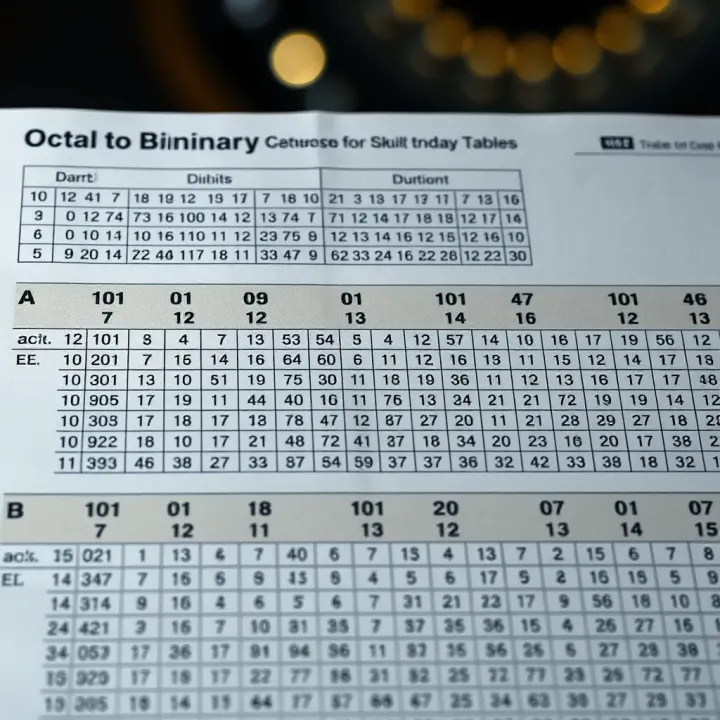
🔢 Learn octal to binary conversion with easy steps, detailed tables, and real examples. Master number systems for better coding and digital understanding! 💻

🔢 Explore how binary numbers work and their key role in computing! Learn conversions, arithmetic, and tech uses with easy examples for all readers.
Based on 13 reviews