

Understanding Binary Numbers: A Simple Guide
🔢 Explore how binary numbers work and their key role in computing! Learn conversions, arithmetic, and tech uses with easy examples for all readers.
Edited By
Thomas Parker
A 4-bit binary adder-subtractor is a fundamental component in digital electronics that performs both addition and subtraction on 4-bit binary numbers. It combines the functions of two separate circuits into one, saving space and improving efficiency in arithmetic operations commonly used in computing devices.
At its core, the circuit uses logic gates like AND, OR, XOR, and NOT to manipulate bits according to binary arithmetic rules. The primary challenge lies in handling subtraction, which the circuit achieves via two’s complement method. This method flips the bits of the subtrahend and adds one, converting subtraction into an addition problem.

How it works practically: If you want to add 0110 (6 in decimal) and 0011 (3), the circuit processes the two binary numbers straightforwardly. But for subtraction, say 0110 (6) minus 0011 (3), the subtrahend (0011) is converted to its two’s complement (i.e., 1101), and then the circuit adds this to the minuend (0110), producing the correct result.
This dual-function circuit often includes a control input bit to switch between addition and subtraction modes, eliminating the need for separate hardware.
Understanding the working of a 4-bit binary adder-subtractor offers direct insight into how computers and calculators handle basic arithmetic. Financial analysts and traders may appreciate how behind-the-scenes digital logic contributes to computational accuracy, affecting trading algorithms and real-time data calculations. Students and freshers in electronics and computer science gain a foundation for more complex subjects like processor design.
Clear knowledge of the 4-bit binary adder-subtractor bridges the gap between theoretical binary math and practical computing operations.
Inputs: Two 4-bit binary numbers plus a mode control bit.
Output: A 4-bit result and a carry/borrow bit indicating overflow or underflow.
Logic Gates: Primarily XOR for conditional inversion of bits; AND, OR for carry generation and propagation.
By learning the detailed truth table of this circuit, readers can predict exact output results for all input combinations, ensuring a thorough grasp of its function.
In the next sections, the article will break down the logic gate setup and explore the truth table comprehensively to clarify how every possible input influences the output.
This knowledge will help you evaluate the accuracy and performance aspects of computation modules in financial software, custom calculators, and embedded systems used within industry applications.
Understanding the basics of binary addition and subtraction is fundamental to grasp how a 4-bit binary adder-subtractor operates. These operations form the building blocks of digital computing, enabling arithmetic calculations inside microprocessors and microcontrollers. For traders, analysts, or anyone involved in digital applications, knowledge of these basics helps decode how computers execute even the simplest calculations.
The binary system uses only two digits, 0 and 1, unlike the decimal system, which has ten digits (0–9). Every binary digit, or bit, represents an increasing power of two, starting from the rightmost bit as 2⁰. For example, the binary number 1011 equals (1×8) + (0×4) + (1×2) + (1×1) = 11 in decimal. This simplicity allows electronic circuits to represent numbers easily using on or off states.
Binary addition follows straightforward rules: 0+0=0, 1+0=1, 0+1=1, and 1+1=0 with a carry of 1 to the next bit. Consider adding 1101 and 1011 (both 4-bit numbers). Starting from the least significant bit: 1+1=0 carry 1, next bit 0+1+carry 1=0 carry 1, then 1+0+carry 1=0 carry 1, and finally 1+1+carry 1=1 carry 1 (overflow). The result is 10000 in binary, but with 4-bit registers, overflow can occur, which the system must handle.
Binary subtraction typically uses the method called two's complement. To subtract a number, it finds the two's complement of the subtrahend and adds it to the minuend. For example, to compute 1010 minus 0110, we take the two's complement of 0110 (which is 1010) and add it to 1010, giving the result 0100 in binary (4 in decimal). This technique simplifies hardware design, as the adder circuit can serve both addition and subtraction functions with slight modifications.
Binary addition and subtraction are not just abstract concepts; they form the core of many computing tasks, from algorithmic trading to data processing, where precise and efficient calculations matter.
This foundational understanding is essential before moving on to the design and operation of a 4-bit binary adder-subtractor circuit, which combines these principles in a compact digital component.
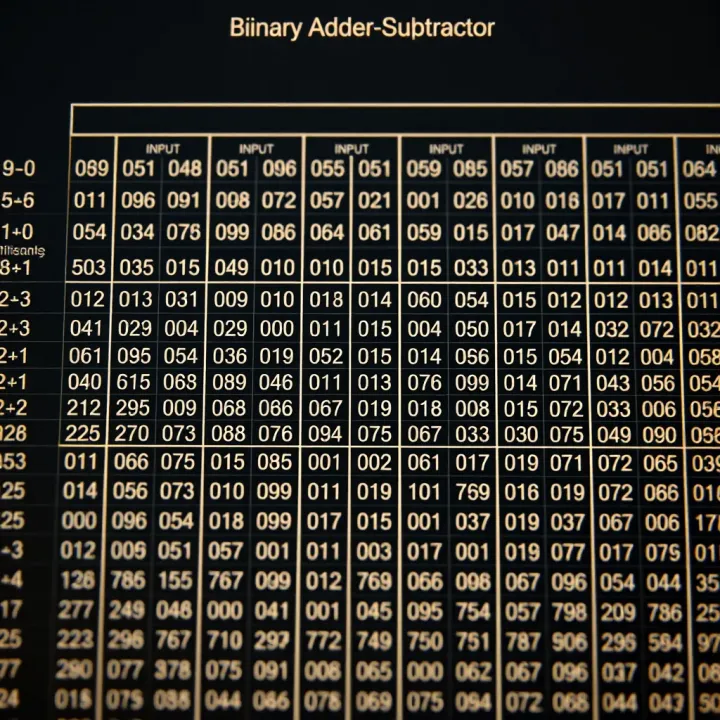
Understanding the design and operation of a 4-bit binary adder-subtractor is essential for grasping how basic arithmetic is handled within digital systems. This circuit combines addition and subtraction functionalities into a single unit, saving space and components in devices like calculators, microprocessors, and embedded systems. Its efficient design helps perform crucial calculations needed in trading algorithms, fiscal data processing, and computational analysis.
The heart of this circuit is to add or subtract two 4-bit binary numbers based on a control input called the mode selector. When this input is 0, the circuit adds the numbers; when set to 1, subtraction takes place. For example, if you want to subtract ₹35 (binary 0010 0011) from ₹50 (binary 0011 0010, shortened to 4 bits for demonstration), the circuit switches mode to subtraction and calculates the binary difference accordingly. The result appears as a 4-bit output, along with flags indicating carry or borrow conditions.
XOR gates play a clever role in switching between addition and subtraction modes without needing separate hardware. Each bit of the second operand is XOR-ed with the mode selector bit. If mode is 0 (add), the operand remains unchanged. If mode is 1 (subtract), each bit flips, effectively performing a bitwise complement. This complements the second number, which—combined with an initial carry-in of 1—enables subtraction using the same adder circuit. This technique avoids the complexity of separate subtract circuits and enhances reliability.
Managing carry and borrow is critical. During addition, a carry-out from any bit addition flows as carry-in to the next higher bit. For subtraction, a borrow occurs when a minuend bit is smaller than the subtrahend bit, which the circuit manages by adjusting carry signals accordingly. The least significant bit gets a carry-in equal to the mode selector, which is 1 for subtraction to complete two’s complement operation. This unified approach ensures the same adder handles both operations smoothly, simplifying the circuitry and maintaining consistent output behaviour.
An efficient 4-bit adder-subtractor circuit reduces the need for extra components and switches seamlessly between adding and subtracting, making it vital in devices where space and speed matter.
This design is simple yet highly functional, making it a staple in digital electronics teaching and real-world applications such as ALUs (Arithmetic Logic Units) in microcontrollers and processors. Understanding it helps students and professionals optimise hardware and troubleshoot arithmetic-related errors effectively.
The truth table of a 4-bit binary adder-subtractor is essential for grasping how the circuit processes every possible input combination to output accurate sums or differences. This table outlines all input bits alongside output results, making it easier for students, traders, and analysts to validate the circuit’s function or simulate it in real-world applications. Without this clear mapping, debugging or designing reliable digital systems, particularly arithmetic logic units (ALUs), would be difficult.
The main inputs of the 4-bit adder-subtractor include two 4-bit binary numbers, typically labelled A (A3, A2, A1, A0) and B (B3, B2, B1, B0), and a single mode control bit, often called M. This M bit decides whether the circuit adds (M = 0) or subtracts (M = 1). The outputs consist of a 4-bit result (S3, S2, S1, S0), which holds the sum or difference, and a carry/borrow output that signals overflow or the need to borrow.
To illustrate, if A is 0110 (decimal 6) and B is 0011 (decimal 3), with M at 0, the output will be 1001, which is 9 in decimal—reflecting addition. Flip M to 1, and the output calculates 0110 minus 0011, resulting in 0011 or 3.
A few key entries from the truth table clarify the adder-subtractor’s behaviour:
Inputs: A = 0001, B = 0010, M = 0 → Output: 0011 (1 + 2 = 3), Carry = 0
Inputs: A = 0100, B = 0011, M = 1 → Output: 0001 (4 - 3 = 1), Borrow = 0
Inputs: A = 0000, B = 0001, M = 1 → Output: 1111 (in 2's complement, representing -1), Borrow = 1
These entries help you anticipate the circuit's logic under different input conditions.
Overflow occurs when the result exceeds the 4-bit range (0 to 15 for unsigned numbers). The truth table tracks overflow by observing the carry and borrow flags. For example, when adding 1111 (15) and 0001 (1), the output turns 0000 with a carry of 1, indicating an overflow.
Flags help signal exceptional situations, making error detection or handling simpler in complex systems. In practical terms, traders and analysts designing digital hardware need to interpret these flags to prevent miscalculations or data corruption during arithmetic operations.
The truth table is not merely a reference — it’s a troubleshooting and design tool, crucial for validating that the 4-bit adder-subtractor operates correctly and efficiently under all conditions.
In summary, understanding the inputs, outputs, sample entries, and overflow indicators in the 4-bit adder-subtractor truth table equips users with the insight to confidently work with this fundamental digital component.
The 4-bit adder-subtractor circuit plays a vital role in basic computer arithmetic. Its ability to perform both addition and subtraction on 4-bit binary numbers makes it a key component in digital systems, especially where resource efficiency and simplicity matter. Understanding its applications helps grasp how fundamental arithmetic operations are handled within modern processors and embedded devices.
Arithmetic Logic Units (ALUs) form the heart of CPUs, carrying out mathematical and logical operations. The 4-bit adder-subtractor serves as a basic building block within ALUs, handling small-width arithmetic tasks efficiently. For example, early microcontrollers and some digital signal processors use similar 4-bit modules for operations like incrementing counters or adjusting small data fields. ALUs rely on such circuits to switch seamlessly between addition and subtraction without extra hardware, cutting down on complexity and power consumption.
Beyond ALUs, the 4-bit adder-subtractor is widely used in digital circuits such as calculators, counters, and simple data processing units. In embedded systems, where memory and chip area are limited, this circuit performs arithmetic where 4-bit precision suffices. Consider digital clocks that maintain time in binary-coded decimal (BCD); a 4-bit subtractor helps decrement values for countdown timers or setting alarms. Its straightforward design also makes it a common teaching aid in electronics and computer engineering courses, giving students hands-on exposure to digital arithmetic implementation.
The main advantage of the 4-bit design is its simplicity and low resource demand. It uses fewer gates and less power, which suits small-scale electronics and initial prototypes. The design is modular; multiple 4-bit units can be combined for higher bit-width operations, providing flexibility. However, this design comes with size limits. It can only handle numbers up to 15 (binary 1111) without overflow, restricting its use in applications requiring larger numerical ranges. Moreover, its speed and precision lag behind wider adders found in modern processors. When extensive computation or high speed is needed, designers move to 8-bit, 16-bit, or 32-bit architectures.
The 4-bit adder-subtractor strikes a balance between simplicity and function, serving well in basic arithmetic tasks while laying the groundwork for more complex arithmetic units.
In summary, by supporting both addition and subtraction in a compact form, the 4-bit adder-subtractor circuit remains important for understanding digital arithmetic and practical electronic designs where modest bit-widths are enough.
When working with 4-bit binary adder-subtractor circuits, understanding common issues and how to troubleshoot them is essential. These circuits form the backbone of arithmetic operations in digital systems, especially in arithmetic logic units (ALUs). Even a minor error in design or operation can lead to incorrect outputs, affecting the performance of larger systems relying on these circuits.
Output errors often stem from incorrect input handling or faulty logic gate connections. For instance, if the XOR gates used for mode selection (addition or subtraction) are miswired, the circuit may produce unexpected results. Similarly, a stuck-at fault in any full adder block can cause wrong sum or carry outputs.
A practical way to spot output errors is by cross-checking with the truth table. If the output does not match expected results for given binary inputs and mode signals, inspecting the connections of carry-in and carry-out lines is necessary. Also, noise or signal degradation in breadboard setups can introduce glitches, so using a proper test bench or simulation software before hardware implementation is advisable.
Overflow occurs when the result of addition exceeds the 4-bit boundary, leading to sign misinterpretation in two's complement form. For example, adding two positive numbers that yield a negative result flags an overflow. Underflow is less common in subtraction but can happen when subtracting a larger number from a smaller one in unsigned arithmetic.
To address these, monitoring the overflow flag is crucial. The overflow condition can be detected by examining the carry into and out of the most significant bit (MSB). If these carries differ, overflow has occurred. Designs often include an overflow indicator output for this purpose. Handling underflow involves deciding how the system should behave—either saturate at zero, wrap around, or flag an error—according to application needs.
Detecting and managing overflow and underflow ensures reliable operations, preventing silent errors in computational tasks.
Preventing errors begins with careful circuit design and testing. Here are some key recommendations:
Verify logic connections: Double-check the wiring of XOR gates, full adders, and carry chains.
Use simulation tools: Before physical assembly, simulate the adder-subtractor using software like Logisim or Multisim.
Debounce inputs: In hardware, ensure input signals are stable to avoid transient faults.
Implement proper flag signals: Overflow, carry, and zero flags help detect abnormal conditions early.
Design for noise immunity: Maintain clean and firm power supply connections, and use proper grounding to reduce signal corruption.
By following these steps, you can improve the reliability of a 4-bit adder-subtractor circuit in practical applications such as embedded systems or digital calculators, ensuring accurate binary arithmetic even under challenging conditions.
🔢 Explore how binary numbers work and their key role in computing! Learn conversions, arithmetic, and tech uses with easy examples for all readers.

Explore numbers in binary form 💻—from basics to decimal conversion, key operations, and real-world applications in computing and electronics 🔢⚡.

🔢 Learn about number systems and master binary to decimal conversion with clear steps and examples. Understand why binary is vital for computing! 💻

🔢 Explore how numbers work in binary code! Learn binary basics, decimal conversions, key operations, and why binary matters in today’s tech world. 💻
Based on 6 reviews