

Understanding Binary Equivalent: A Clear Guide
Learn binary equivalent clearly! Understand conversion from decimal, explore everyday tech use, and troubleshoot common issues easily in Indian context. 💻🔢
Edited By
Emma Lawson
The 4-bit binary ripple counter is a fundamental digital circuit widely used in electronics, especially in timing, frequency division, and simple counting tasks. It consists of a cascade of flip-flops—usually JK or T type—where each stage acts as a binary digit, toggling between 0 and 1. This arrangement counts from 0 to 15 (2^4 - 1), providing a straightforward way to keep track of events.
Unlike synchronous counters, where all flip-flops receive a common clock signal simultaneously, the ripple counter's flip-flops trigger sequentially. The output from one stage clocks the next, causing a slight delay or 'rippling' effect as the signal progresses through each bit. This delay, known as propagation delay, can impact timing accuracy, making ripple counters better suited for low-frequency applications.
Simple design: With minimal components, it is easy to implement and troubleshoot.
Compact: Uses fewer wiring connections compared to synchronous designs.
Cost-effective: Suitable for cost-sensitive applications, especially in low-frequency domains.
However, its ripple effect can cause timing errors when counting rapidly. This limits its use in high-speed digital circuits, where synchronous counters offer better performance.
An example practical use is in digital clocks, where a 4-bit ripple counter segments the seconds or minutes into binary counts for display or further processing.
In trading or analytical hardware systems, such counters may assist in managing event counts or timing pulses, contributing to precise operation without complexity. Understanding the ripple counter’s design trade-offs helps you consider when to opt for it against more advanced counters.
Next, we will look closely at the working principle and how to design such a counter step by step.
Understanding the basics of the 4-bit binary ripple counter is key to grasping how simple digital counting circuits operate. This counter is a fundamental building block in electronic devices that require counting or timing functions, such as clocks, frequency dividers, and basic measurement tools. It serves as an excellent starting point for students and professionals looking to comprehend sequential logic and digital electronics.
A binary counter is a sequential digital circuit that progresses through a predetermined sequence of binary numbers in response to clock pulses. Specifically, a 4-bit binary counter counts from 0 (0000) to 15 (1111) in binary form as it receives input pulses. This counting function plays a practical role in scenarios like keeping track of events, measuring elapsed time, or dividing frequencies in communication systems.
Binary counting relies on the base-2 number system, where each bit represents a power of 2. For instance, in a 4-bit setup, the bits correspond to 2³, 2², 2¹, and 2⁰, respectively. When counting, the rightmost bit toggles with every pulse, while each bit to the left toggles only when all bits to its right have completed a full cycle. This binary progression allows efficient representation of numbers using electronic switch states — OFF (0) or ON (1).
The ripple counter gets its name from the 'ripple' effect of the signal as it passes through each flip-flop stage. In a 4-bit ripple counter, the output of one flip-flop acts as the clock input for the next. When the first flip-flop toggles, the change ripples to the second flip-flop, then to the third, and so on, sequentially. This means that each flip-flop does not switch simultaneously but with a delay caused by the preceding stage.
This behaviour is useful in simple timing circuits, but it creates a delay proportional to the number of bits. For example, in a 4-bit counter, the final output bit changes after a small but noticeable time lag compared to the initial clock pulse.
Unlike ripple counters, synchronous counters have all flip-flops triggered by the same clock signal simultaneously. This design eliminates ripple delays, offering faster and more reliable counting, especially important in high-speed applications like microprocessor timers or communication devices.
However, synchronous counters require more complex circuitry, increasing cost and design difficulty. Ripple counters, while slower, are easier to implement and often sufficient for low-speed tasks, such as basic event counting or simple timing where precise synchronisation is not critical.
Ripple counters provide a simple yet effective way to count in binary but limit speed due to propagation delays. Understanding this helps decide when to use them over synchronous alternatives in practical electronics design.
Understanding how a 4-bit ripple counter is designed and operates is key to its effective use in digital electronics. This counter is built using simple components, yet it accomplishes binary counting across four bits, making it useful in applications like timing and frequency division.
The 4-bit ripple counter primarily uses JK flip-flops, which switch states based on their inputs and clock pulses. Each JK flip-flop can toggle its output when both inputs are high, making it ideal for counting. Using JK flip-flops simplifies the circuit design since they eliminate the need for additional gates to control toggling.
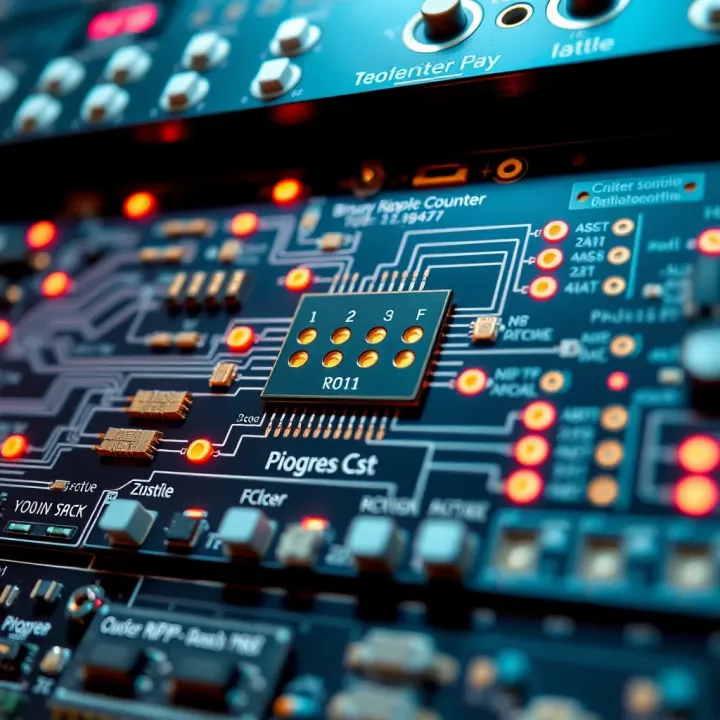
In this counter, four JK flip-flops connect in series. Each flip-flop represents one bit of the binary count, starting from the least significant bit (LSB) to the most significant bit (MSB).
The clock signal drives the counter, but unlike synchronous counters, in a ripple counter, this clock is applied only to the first flip-flop. The subsequent flip-flops receive clock pulses from the output of the previous flip-flop. This creates a "ripple" effect where the clock signal appears to cascade through the flip-flops.
This setup reduces complexity as only one external clock line is needed. However, the change in state propagates slowly from one flip-flop to the next, which affects speed, especially in high-frequency applications.
The outputs of the JK flip-flops are arranged to represent the binary count directly. Each output corresponds to a bit, with the first flip-flop outputting the LSB and the last the MSB.
This arrangement allows easy readability of the binary count and convenient interfacing with other digital components. For example, connecting these outputs to LEDs provides a simple visual indication of the count progression.
A 4-bit ripple counter cycles through 16 states, from 0000 (0 decimal) to 1111 (15 decimal). On each clock pulse, it increments the current count by one in binary form.
This straightforward progression makes it useful for simple counting tasks. For instance, in a timing circuit, each state could represent a fixed time interval, enabling functions like seconds counting in clocks.
Each flip-flop toggles when its clock input receives a falling or rising edge, depending on configuration. The first flip-flop toggles on every clock pulse, the second toggles when the first output changes from 1 to 0, and so on.
This means the LSB flips most frequently, while the MSB flips last. Such toggling behaviour follows binary rules, where each bit changes state after its lower-order bits complete a full cycle.
The ripple effect causes delays between bits changing state, which is key to understand when timing or synchronisation is critical.
In summary, knowing the design and operation specifics helps in selecting the ripple counter for the right application and managing its limitations effectively.
Timing characteristics define how the 4-bit binary ripple counter performs over time, especially how quickly it responds to input changes. Understanding these aspects is key for anyone designing or working with such counters in real applications. Limitations arise due to the inherent design where each flip-flop output triggers the next, causing a delay known as propagation delay. This delay affects counting speed and can introduce errors if not carefully managed.
Propagation delay is the time taken for the output of one flip-flop to change after its input clock edge. In ripple counters, this delay accumulates because the output of each flip-flop feeds the clock input of the next. For example, the fourth flip-flop in a 4-bit ripple counter changes state only after the first three have toggled, leading to a cumulative delay.
This delay means that the output bits do not change simultaneously, which can cause a temporary incorrect count during transitions. In practical terms, if the counter is used to drive a digital display, this delay may cause brief flickers or glitches until the final state stabilises. For applications like digital clocks or simple timers running at moderate speeds, this issue is usually manageable.
In high-speed applications, however, propagation delay becomes a serious challenge. The longer the delay chain, the slower the maximum clock frequency the counter can handle. For example, ripple counters struggle in fast frequency division or high-speed data sampling because the bits don't update in sync, leading to unreliable counts. Designers often avoid ripple counters in such scenarios or introduce synchronising circuits to overcome this.
Glitches and counting errors are common problems caused by the ripple effect. When the output bits toggle at slightly different times because of delays, transient states can occur that look like invalid counts. These glitches may cause errors if subsequent circuitry samples the counter output too quickly, before it settles to the correct value. For instance, a microcontroller reading a ripple counter output at high speed might misinterpret the count.
To avoid glitches, the output should be latched or delayed until stable. Sometimes designers use synchronous counters instead which update all bits simultaneously, avoiding such issues altogether.
Power consumption is another important consideration. Ripple counters can draw more power during switching due to the sequential toggling of flip-flops. Each transition causes short spikes of current, and with all flip-flops toggling in sequence, overall consumption rises. While this may not matter in small-scale or battery-powered applications, in complex systems or those requiring energy efficiency, minimising switching activity becomes important.
In summary, while the 4-bit binary ripple counter serves well in many low-to-mid-speed applications, managing delays, glitches, and power demands is necessary for reliable operation, especially when speed or precision demands increase.
Understanding timing limitations helps in choosing the right counter design and ensuring dependable electronic system performance.
The 4-bit binary ripple counter finds widespread use in digital electronics due to its simplicity and efficiency in basic counting tasks. Its practical significance lies in how it breaks down complex timing and counting problems into manageable bits, making it a preferred choice for systems where moderate speed and straightforward design matter.
In digital clocks, the 4-bit ripple counter serves as a key building block for counting seconds, minutes, and hours. Each flip-flop in the counter toggles with every input pulse, which can be derived from a crystal oscillator. For example, dividing a 1 Hz pulse can help the counter keep track of seconds up to 15 (binary 1111). This simplified counting method is especially handy in wristwatches or basic timer circuits where minimal hardware keeps costs low. However, due to the ripple delay, these counters suit only lower-frequency timers where the slight lag doesn’t impact accuracy.
Frequency division is another major application of the 4-bit ripple counter. When you feed a high-frequency clock signal to the input, the output pins produce signals at progressively halved frequencies. For instance, the first flip-flop divides the frequency by two, the second by four, and so on, up to a division by sixteen at the fourth flip-flop. This characteristic is useful in telecommunications and signal processing devices where precise lower frequencies are required from a high-frequency source. Indian engineers working on communication modules often rely on ripple counters during initial prototyping for this purpose before moving to more complex synchronous counters.
For simple counting operations such as event tallying, button presses, or object counting on a conveyor belt, the 4-bit ripple counter offers an easy hardware solution. Its straightforward cascading design is less complex to implement when the requirement is just to count up to 15 and then reset. Devices in factories or retail points often use these counters for basic inventory or process monitoring. While the counter isn’t suitable for high-speed industrial automation due to timing drawbacks, it performs well in entry-level systems without stringent speed demands.
The 4-bit ripple counter balances ease of design with functional capability, proving itself valuable in many practical digital applications where simplicity and cost savings matter more than ultra-fast processing.
In sum, the 4-bit ripple counter remains relevant in practical electronics through clocks, frequency dividers, and simple counters. These applications highlight how design trade-offs accommodate the needs of diverse systems, especially in Indian contexts where cost-effectiveness aligns with functional reliability.
Comparing the 4-bit binary ripple counter with other counter types helps clarify its strengths and weaknesses. This allows you to choose the right counter for your specific application, whether that is speed, complexity, or cost. Understanding these differences ensures your design meets performance and budget needs effectively.
Speed and timing differences
Synchronous counters update all their flip-flops simultaneously based on a common clock signal. This eliminates the ripple delay seen in ripple counters, where the clock pulse cascades through each flip-flop in sequence. Because of this, synchronous counters operate faster and more reliably in high-speed circuits, such as microprocessor timers or high-frequency dividers used in communication equipment. For instance, in a clock divider for Indian Railways signalling, synchronous designs prevent timing errors caused by ripple delays.
Complexity and cost factors
Despite their speed benefits, synchronous counters require more complex circuitry due to additional combinational logic for simultaneous clocking. This drives up the component count and, in turn, increases cost and power consumption. Ripple counters, on the other hand, use fewer gates and simpler wiring, making them ideal for low-cost, low-speed applications where budget is a key consideration. For example, a basic event counter in a water meter might favour a ripple counter for cost-effectiveness over speed.
Operational differences
Ring counters circulate a single ‘1’ or ‘0’ bit through a series of flip-flops, while Johnson counters cycle through a pattern of bits generated by feeding back complements. Both counters have fixed counting sequences unlike ripple counters that count in binary. This makes ring and Johnson counters particularly useful for applications requiring specific sequence control, such as LED chasers or stepper motor controllers in automation systems.
Use case comparisons
Ripple counters excel in simple counting tasks with binary output, helpful in divide-by-16 counters or digital clocks. Ring counters shine in applications demanding precise state control with minimal glitch, while Johnson counters balance between counting and waveform generation. Consider a factory conveyor system: a Johnson counter provides smooth sequence control for motor steps, whereas a ripple counter might struggle due to timing delays. Choosing between these depends on the nature of the counting and control task involved.
Understanding these distinctions helps design engineers and electronics enthusiasts select the best counter type based on speed, complexity, and operational needs.
This knowledge is especially useful for traders and analysts who are evaluating technology or hardware components, ensuring informed decisions aligned with application requirements.
Designing a reliable 4-bit binary ripple counter needs careful attention to detail. Small oversights can introduce delays and errors that affect overall circuit performance. Keeping this in mind, understanding practical design tips helps improve both speed and stability in your application.
Ripple counters naturally suffer from propagation delay because each flip-flop waits for a toggle from the previous stage. To minimise this impact, use high-speed flip-flops with low propagation times, such as those based on CMOS technology or modern TTL variants. For example, choosing 74HC series flip-flops instead of older 74LS can notably reduce delay. Additionally, careful PCB layout reducing stray capacitance helps prevent signal degradation. Designing the clock input to provide clean, sharp transitions also improves reliability and reduces glitches. Sometimes adding buffering stages between flip-flops smartly manages delays, though this increases circuit complexity.
Selecting the right flip-flop impacts both power consumption and speed. JK flip-flops are common for ripple counters due to their toggle nature, but T flip-flops or D flip-flops configured to toggle can also work. Prefer flip-flops with clear preset and reset pins to help initialise the overall counter state easily during testing or power-up. In Indian electronics markets, commonly available ICs like 74HC112 (JK flip-flop) provide good balance between cost and performance. Also consider operating voltage and temperature range; industrial-grade components are better where environmental conditions vary significantly.
Testing ripple counters means checking both correct counting and timing consistency. The simplest way is to feed known clock pulses and observe output with a logic analyser or oscilloscope. Eye on glitches is critical — any unintended transitions usually indicate wiring errors or noise problems. Using LEDs on output lines is a low-cost way to visualise counting progression for beginners. For deeper debugging, inject manual resets and check the counter’s ability to return to zero state. Additionally, if the counter fails to reach maximum count, verify flip-flop connections and clock signal integrity. Documenting issues step by step often saves time rather than random swaps.
Good design practices in ripple counters reduce headaches in applications like digital clocks, timers, and frequency dividers where timing accuracy directly affects performance.
In summary, focusing on quality flip-flops, tackling propagation delays through hardware choices and layout, and systematic testing will make your 4-bit binary ripple counter stable and dependable for real-world use.
Learn binary equivalent clearly! Understand conversion from decimal, explore everyday tech use, and troubleshoot common issues easily in Indian context. 💻🔢

Explore binary tree traversal techniques — inorder, preorder, and postorder with practical examples and useful tips to enhance your data structure skills 📚🌳

Explore how the binary system powers digital devices and calculators process binary data 🖥️. Understand binary basics, calculator functions, plus practical examples.

Discover how binary code translators convert computer language into readable formats 💻, their key functions, common tools, and real-world applications in IT and programming.
Based on 11 reviews