
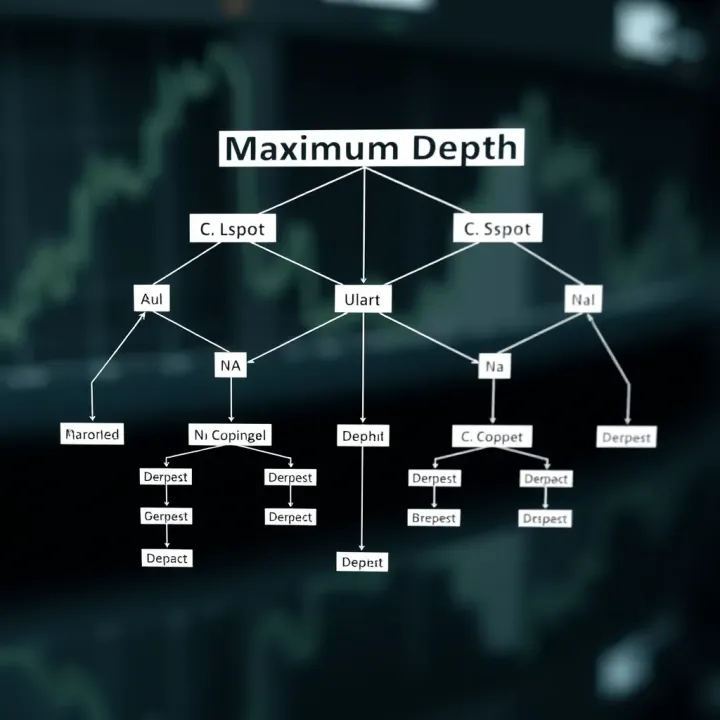
Understanding Maximum Depth of a Binary Tree
🌳 Explore how to calculate the maximum depth of a binary tree, understand its importance, and see examples. Learn about balanced trees & common challenges! 📊
Edited By
Charlotte Green
Binary trees form the backbone of many algorithms and data structures, especially in computer science and finance applications. Traversing a binary tree means visiting all the nodes in a systematic order. Understanding these traversal methods helps traders, analysts, and students manipulate hierarchical data more effectively.
There are three primary binary tree traversal techniques:

Inorder traversal: Visits the left subtree, then the current node, followed by the right subtree.
Preorder traversal: Visits the current node first, then the left subtree, and finally the right subtree.
Postorder traversal: Visits the left subtree, then the right subtree, and ends with the current node.
Each traversal serves different purposes. For example, inorder traversal of a binary search tree (BST) gives nodes in sorted order, useful for quick lookups. Preorder is often used in copying or serialising trees, while postorder helps in deleting nodes or evaluating expression trees.
Traversing a binary tree correctly can simplify complex operations like parsing market data structures or analysing hierarchical risk models.
Here's a quick example: imagine a binary tree representing a company's organisational chart. Using preorder traversal, you list the manager first, followed by their direct reports recursively, giving a top-down view.
By practising these traversal methods with concrete examples, you can gain a strong grip on tree data structures, which are widely used in database indexing, stock market data storage, and decision trees in trading algorithms.
In the next sections, we will discuss each traversal technique with practical code snippets and real-world use cases relevant to financial and analytical professionals.
Understanding binary trees is vital for anyone dealing with hierarchical data structures, whether you are analysing stock movements or managing complex databases. Binary trees provide a way to organise data so that operations such as search, insert, and delete can be performed efficiently. In this section, we focus on their structure and traversal methods, key to leveraging their full potential.
At its core, a binary tree is a collection of nodes where each node has at most two children, known as the left and right child. This property makes the tree highly flexible for representing hierarchical information, like the chain of financial transactions or organisational charts in trading firms. The root node acts as the entry point, while leaf nodes have no children. The binary tree's height influences operations’ efficiency — the lower the height, typically, the faster the retrieval or update.
There are several categories of binary trees, each with unique traits affecting performance. A full binary tree has every node with either zero or two children — handy in scenarios like expression parsing where operands and operators fit this pattern. A complete binary tree fills all levels except possibly the last, which is filled from left to right; this structure is common in heaps used in priority queues, valuable for scheduling in trading systems. Lastly, a balanced binary tree keeps height differences between subtrees minimal, ensuring operations like search execute in roughly logarithmic time even with large datasets.
Traversal is simply the process of visiting all nodes in a tree systematically. For traders or analysts, this is akin to going through every entry in a ledger or database. Traversal helps in retrieving or updating information stored at nodes and is fundamental to most binary tree operations. Depending on the traversal type, the order of accessing nodes changes, enabling different data insights or processing flows.
Traversing is not just about visiting nodes—it’s about accessing data in an order that fits your need. For instance, inorder traversal processes nodes in a way that can retrieve sorted data from binary search trees, beneficial for stock price analyses or client records sorted by date. On the other hand, preorder traversal is useful for creating a copy of the tree structure, which can assist in backup tasks or transmitting data between trading platforms. Understanding traversal lets you craft efficient algorithms for searching, modifying, or displaying complex financial datasets.
Traversing binary trees efficiently underpins many practical applications in data handling, from portfolio management to fraud detection.
By grasping these basics, you prepare yourself to dive into more advanced traversal techniques that optimise data operations in your trading or analytical systems.
Binary tree traversal techniques form the backbone of accessing and manipulating tree data structures efficiently. Grasping these methods helps traders, analysts, and students alike when dealing with hierarchical data models or decision trees. The main traversal methods—inorder, preorder, and postorder—each follow a specific node visiting order, offering different insights depending on the use case.

Inorder traversal visits nodes in the sequence: left subtree, root node, then right subtree. This method systematically explores nodes by first going deep into the leftmost branch before backtracking to the root and then moving right. It suits binary search trees (BST) because it outputs node values in sorted order.
Consider a simple binary tree with root 10, left child 5, and right child 15. Inorder traversal visits 5 first (left child), then 10 (root), and finally 15 (right child). This ordered access is crucial when you want sorted data without additional processing.
Inorder traversal is widely used in BST operations, such as sorting and searching. It enables investors or analysts to retrieve financial data or decision metrics in ascending order, simplifying subsequent analysis or reports.
Preorder traversal follows the order: root, left subtree, then right subtree. This approach captures the root node first, making it useful for copying or serialising trees where preserving the root structure upfront matters.
Using the same tree (root 10, left 5, right 15), preorder visits 10 first, then 5, and finally 15. This sequence reflects how you would write or transmit tree data starting from the top.
Preorder is beneficial when constructing expressions or prefix notation in compilers or evaluating hierarchical decisions. Traders might use this when mapping scenarios where the root decision is prioritised before exploring options.
Postorder goes left subtree, right subtree, then root. By visiting children before the parent node, it suits scenarios needing bottom-up processing of data.
With a tree having 10 at root and children 5 (left) and 15 (right), postorder visits 5, then 15, and finally 10. This ensures all subtrees are fully explored before the root.
Postorder traversal is key in resource management, such as deleting nodes in compilers or cleaning hierarchical structures. Analysts can use it to process dependencies or aggregate values after examining all subcomponents.
Understanding these traversal techniques deepens your ability to efficiently handle data trees, informing better choices in coding, finance, and analysis.
Beyond the standard inorder, preorder, and postorder traversals, additional methods and variations offer efficient ways to access nodes in a binary tree depending on the task. These alternative approaches provide flexibility for specific applications and improve performance under certain conditions.
Breadth-first traversal concept: Level order traversal visits nodes level by level from top to bottom, moving left to right within each level. Unlike depth-first methods that explore as far down a branch as possible, this method explores all nodes at the current depth before proceeding deeper. This is practical when the breadth of information at a given depth is more vital than deeper nodes.
Implementation with queue: A queue structure supports this breadth-first approach efficiently. Nodes are enqueued starting from the root and dequeued one by one, with each dequeued node’s children added to the queue. This ensures nodes are processed in exactly the right level order. For example, in a binary tree representing company hierarchy, level order traversal lists employees by their reporting level.
Practical scenarios: Level order traversal is useful in scenarios like finding the shortest path in networking or hierarchical data processing where layered access matters. For traders, it can model decision trees where each level represents a stage in strategy. It helps in serialising trees for storage or visualising structures like file systems clearly.
Morris traversal for inorder without stack: Morris traversal finds inorder nodes without extra space by temporarily modifying the tree links to create threads. It avoids the stack or recursion overhead often seen in tree traversals. While a bit trickier to implement, it conserves memory, which is useful in memory-constrained environments or large-scale data.
Threaded binary trees: These trees have special pointers called threads that replace null pointers, linking nodes in their inorder sequence. This enables efficient traversal without recursion or stacks, improving speed for repeated traversals. It's particularly helpful for databases indexing or embedded systems where fast and lightweight operations are essential.
These variations enhance how data structures can be navigated, making binary trees versatile tools across diverse applications from algorithmic trading models to memory-sensitive embedded systems.
Coding binary tree traversal is an essential skill to practically apply the concepts discussed before. It makes these theoretical methods useful for real-world applications such as parsing expressions, managing hierarchical data, or implementing search algorithms. Writing code allows you to see how traversal affects data access and manipulation in concrete terms.
When you implement traversal, understanding the trade-offs in different approaches guides efficient use of resources like memory and processing time. Moreover, practical coding enhances debugging skills and helps you handle edge cases effectively, which is vital for robust applications.
Recursion mirrors the very nature of tree traversal since each node typically leads to similar subproblems—traversing its children. This makes recursive solutions straightforward and concise. The recursive method is elegant and fits easily into functions with clear base and recursive cases, providing readable code that expresses the traversal sequence naturally.
However, recursion also has limits. In deeper or skewed trees, recursion risks stack overflow errors due to too many function calls. It also can be less efficient in terms of memory because each recursive call adds to the call stack.
Here’s how a simple recursive inorder traversal looks in Python:
python class Node: def init(self, key): self.left = None self.right = None self.val = key
def inorder(root): if root: inorder(root.left) print(root.val, end=' ') inorder(root.right)
This code is easy to understand and implement in most common programming languages like Java, C++, or JavaScript, where the concept remains the same.

### Iterative Approaches

Iterative traversal replaces recursion with explicit data structures such as stacks or queues. Using stacks simulates function call behaviour for depth-first traversals (inorder, preorder, postorder), while queues assist in breadth-first or level order traversal.

An iterative method is often preferred in environments with limited stack size or where performance matters, such as embedded systems. It gives fine control over memory usage and execution order and avoids the risk of recursion limits.

Example snippet showing iterative inorder traversal using a stack in Java:

```java
public void inorderIterative(Node root)
    StackNode> stack = new Stack();
    Node current = root;
    while (current != null || !stack.isEmpty())
        while (current != null)
            stack.push(current);
            current = current.left;
        current = stack.pop();
        System.out.print(current.val + " ");
        current = current.right;
This example demonstrates clear stack operations complementing traversal logic, which helps in scenarios where recursion is not suitable.
Comparing recursion and iteration often boils down to simplicity versus control. Recursion offers cleaner code and easier understanding, while iteration provides better memory management and control in performance-critical situations. Knowing both methods prepares you to choose the right tool depending on your application's requirements.
Mastering both recursive and iterative traversal techniques builds a strong foundation in binary tree manipulation, enabling you to tackle a variety of programming challenges efficiently.
In binary tree traversal, understanding performance factors like time and space complexity helps you pick the right method for your needs. Each traversal technique—be it inorder, preorder, postorder, or level order—has different impacts on speed and memory. This section guides you on these key considerations to make your code both efficient and effective.
Traversal methods generally run in linear time, O(n), where n is the number of nodes. This is because each node must be visited once at minimum. For example, both inorder and preorder traversals scan every node, so they perform equally in terms of time. However, level order traversal, which relies on a queue to hold nodes at each level, might slightly increase overhead in practical use, especially for very wide trees.
Space complexity varies more widely. Recursive traversal methods use call stacks proportional to the tree height—O(h). For balanced trees, h is about log n, making recursion fairly efficient. But skewed trees can degrade to O(n) space, risking stack overflow. Iterative methods control this with explicit stacks or queues, which also have space proportional to tree height or width. Understanding this helps when working on memory-constrained systems or large datasets.
Choosing the right traversal depends strongly on your task. For instance, inorder traversal excels in binary search trees since it returns sorted data, ideal when sorting or searching is needed. Preorder traversal suits situations like copying a tree structure or prefix expression evaluation because it visits nodes before their children. Postorder traversal helps clean up resources in tree deletion or in evaluating postfix expressions. Matching traversal to the specific use case avoids unnecessary processing and optimises runtime.
Handling edge cases is crucial for robust traversal code. For example, empty trees should not cause errors but return appropriate responses. Single-node or highly unbalanced trees need testing since recursive stack depth might grow unexpectedly. Defensive coding practices, such as checking null pointers and validating input trees, minimise bugs and runtime crashes. These practical tips ensure your traversal implementations perform reliably in real-world scenarios.
Efficient binary tree traversal balances speed and memory use, fitting the approach to the problem while anticipating special cases.
By keeping these performance and practical points in mind, you can write traversal code that works well across apps, whether analysing market trees or managing large data indexes.
🌳 Explore how to calculate the maximum depth of a binary tree, understand its importance, and see examples. Learn about balanced trees & common challenges! 📊
Explore how level order traversal visits every binary tree node layer by layer, top-down and left-right. Learn implementation tips, examples, and its applications 📚🌳.

🔢 Explore how binary numbers work and their key role in computing! Learn conversions, arithmetic, and tech uses with easy examples for all readers.

Explore numbers in binary form 💻—from basics to decimal conversion, key operations, and real-world applications in computing and electronics 🔢⚡.
Based on 15 reviews