

Understanding Binary Tree Height: Key Concepts & Methods
🌳 Explore the height of a binary tree, why it matters in data structures, and learn efficient recursive & iterative methods with examples, challenges, and optimisations.
Edited By
James Thornton
A binary search tree (BST) is a popular data structure used in computer science to organise data for quick search, insertion, and deletion operations. The height of a BST plays a significant role in how efficiently these operations perform. Simply put, the height of a BST is the length of the longest path from the root node down to the farthest leaf node.
Understanding the height is important because it directly impacts the time complexity of searching or inserting an element. For instance, in an ideal, balanced BST with n nodes, the height is roughly log₂n, allowing operations to run in logarithmic time — very efficient for large datasets. However, if the BST becomes skewed (like a linked list), the height can be as large as n, degrading performance to linear time.

The height of the BST reflects the tree's balance and hence is critical for maintaining fast data retrieval and update times.
Consider a stock trading application tracking thousands of transactions indexed by time or price. Using a BST with a high height could mean slow search times during busy trading hours, which is undesirable. Investors and analysts looking for quick data insights benefit from tightly balanced BSTs where height is controlled.
Calculating the height involves examining nodes from the root and recursively finding the greater height between the left and right subtrees, adding one for the current node. This helps in evaluating tree structure dynamically as data changes. Software engineers often implement such calculations to monitor and rebalance BSTs in real-time applications.
In the following sections, we will explore practical methods to compute BST height, how tree height affects algorithmic efficiency, and what strategies can help keep BSTs balanced for optimal performance.
This knowledge is especially valuable for students, brokers, and developers who deal with sorting, searching, and data management in financial applications or large-scale systems.
The height determines the longest path from the root node down to any leaf. This measure helps assess the tree’s overall balance and efficiency. A taller BST often means some branches stretch too far, causing slower search times, while a shorter height indicates a more balanced structure. By defining height properly, we can better grasp why certain BST operations take longer and how to optimise the tree for faster performance.
A binary search tree is a structured type of binary tree where each node has at most two children, often called left and right child. It follows an ordering rule: the left child contains values less than the parent node, whereas the right child has values greater than the parent. This organisation allows for efficient searching because it narrows down the search space by half at each step.
For example, if you are storing stock prices in a BST, the left subtree of a node holding ₹1,000 will only have prices below ₹1,000, and the right subtree only values above ₹1,000. This structured layout significantly speeds up look-ups compared to an unsorted list.
Tree height is the count of edges in the longest path from the root node to a leaf node, where a leaf is a node without children. This path essentially represents the deepest branch in the tree. For example, in a BST managing user portfolio details, the height reflects the worst-case depth for finding a portfolio.
A height of 0 means the tree has only one node (the root), while a height of 3 or 4 indicates some paths take several levels to reach a leaf. Practically, the higher the tree, the longer the search or insertion process since each step traverses one edge.
Height and depth might seem similar but address different perspectives. Depth refers to how far a node is from the root, i.e., the number of edges from the root to that node. On the other hand, height measures how far the node is from its deepest descendant leaf.
For instance, the root node’s depth is zero since it’s at the top, but its height is equal to the longest subtree chain below it. Meanwhile, a leaf node’s height is zero because it has no children, but its depth depends on the path from the root. Understanding this contrast helps in evaluating both how deep a node sits in the tree and how tall the branch connected to it is.
Knowing these definitions precisely is key to optimising BST operations, which affects how data structures perform in real-world applications such as finance or analytics platforms.
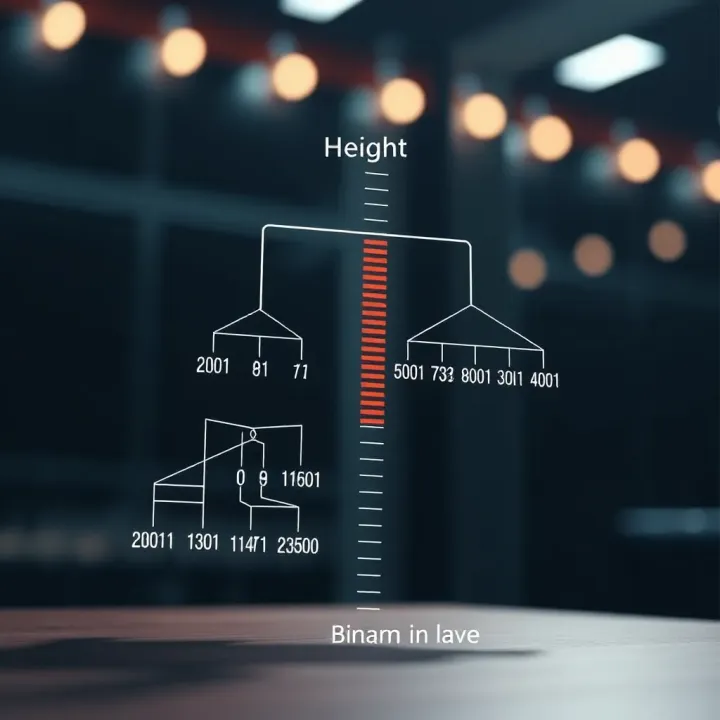
Calculating the height of a binary search tree (BST) is a cornerstone for understanding its performance, especially when you want to optimise search and insertion operations. The height essentially dictates the efficiency of these operations, so knowing how to find it accurately matters. Whether you're writing algorithms or analysing data structures, understanding the measurement of tree height saves you time and computational resources.
The most common and natural way to calculate the height of a BST is through a recursive approach. This method works by diving down from the root node through its children, finding the height of each subtree, and then picking the greater one. Practically, you check if the node is null—if yes, the height is zero because no nodes exist there. Otherwise, recursively determine the height of the left and right subtrees, then add one for the current node itself.
For example, suppose you have a BST where the left subtree height is 3 and the right subtree height is 5. The recursive method will return 6 as the total height (5 plus 1 for the root). This method fits well because it directly reflects the tree structure. For coding beginners, it's straightforward to implement by returning 0 when hitting a null node and using max function between heights of subtrees before adding 1.
While the recursive method suits most cases, iterative techniques exist but come with limitations. Iterative height calculation often uses level order traversal, also known as breadth-first search (BFS). You keep track of nodes level by level using a queue. Each iteration through the queue increments the height count until all nodes are processed.
The challenge with iterative methods is managing the queue size for very large or heavily unbalanced trees. It can lead to higher memory consumption compared to recursion, which depends largely on the depth of the tree. Plus, writing an iterative version is somewhat more complex, making it less popular for simple height calculations.
Recursive calculation is generally preferred for clarity, while iterative methods may suit situations where function call stack limits are a concern.
Understanding these methods lets you choose the right approach depending on context—whether you want simplicity or need to manage specific performance constraints. Calculating BST height correctly benefits optimisations in searching, inserting, and deleting nodes crucial for traders, analysts, and developers working with complex data.
The height of a binary search tree (BST) heavily influences how quickly one can perform search operations. A tree with lower height generally means fewer steps to reach any node, which leads to faster data retrieval. Conversely, higher tree height, often caused by an unbalanced structure, can slow down searches significantly. This section explores how tree height impacts search speed and overall performance in BST operations.
When a BST is balanced, it maintains roughly equal numbers of nodes in left and right subtrees, keeping the height close to the minimum possible for the number of nodes. For example, a balanced BST with 1 lakh nodes typically has a height of around 17 (since log2(1,00,000) ≈ 16.6). This balance allows searching to complete in about 17 comparisons in the worst case, making the process efficient.
On the other hand, an unbalanced tree, say one built by inserting already sorted data, can degenerate into a structure resembling a linked list. Here, the height becomes linear with the number of nodes, reaching up to 1 lakh for the same amount of data. Searching in such a tree might require over 1 lakh comparisons, which is highly inefficient.
Search performance in BSTs can degrade drastically if the tree is unbalanced, so maintaining balance is critical for efficiency.
The height of a BST directly affects the time complexity of core operations: search, insertion, and deletion. All of these operations generally run in O(h) time, where h is the height of the tree. Thus, for a balanced tree with height h ~ log n (n being the number of nodes), these operations run in logarithmic time, or O(log n). That's why balanced BSTs like AVL or Red-Black trees are common in practice—they guarantee O(log n) time even in the worst case.
In contrast, an unbalanced BST’s height can climb close to n, causing the time complexity for these operations to degrade to O(n). This means that operations that should ideally complete quickly become sluggish with growing data size. To illustrate, if an investor’s trading algorithm uses a BST for storing transaction data, an unbalanced structure can lead to delays affecting real-time decision making.
In summary, controlling the height of a BST is essential for maintaining fast search and update operations. As you deal with larger datasets, be mindful of insertion order and consider balancing techniques to avoid height-related slowdowns.
Understanding what influences the height of a Binary Search Tree (BST) is key for anyone dealing with search and sort operations. The height affects the efficiency of search, insert, and delete operations—so, knowing these factors can help in designing better-performing trees. Two major influences take the spotlight here: the order in which nodes are inserted and the overall tree structure that develops from these insertions.
The order in which nodes are inserted into a BST can make or break its efficiency. For instance, inserting elements in ascending or descending order causes the tree to become skewed, resembling a linked list, pushing the height to almost the number of nodes. Take inserting values 10, 20, 30, 40, and 50 sequentially into a BST; instead of a balanced tree, it degenerates into a straight line with height 5. This drastically slows down search times, making them linear rather than logarithmic.
Conversely, inserting nodes in a random or carefully chosen order can keep the tree balanced and height minimal. Random insertion tends to produce a tree with expected height close to log₂n, where n is the number of nodes, giving better performance. In practice, algorithms that randomise insertion order, or data structures like treaps and randomised BSTs, rely on this principle to maintain efficiency.
Apart from insertion order, the shape or structure of the tree itself influences its height. A balanced tree, where the left and right subtrees of every node differ little in height, keeps operations fast. Self-balancing trees such as AVL or Red-Black trees actively maintain this structure by rotating nodes during insertions and deletions to restrict height growth.
On the other hand, unbalanced trees grow unevenly. Consider a BST where most nodes cluster on one side due to data patterns or insertion sequences — this imbalance increases height unnecessarily and hits search efficiency. Even subtle variations in structure, like having many nodes at one subtree and fewer on the other, compound over time to affect the tree’s performance.
Keeping a BST’s height low hinges on how well you manage insertion order and tree structure. Ignoring these can degrade what should be a fast search into a slow, linear scan.
To sum up, controlling insertion order and monitoring tree shape are practical ways to ensure your BST performs efficiently. Both aspects are crucial for traders, analysts, and students working with data organization and retrieval, where speed and accuracy matter deeply.
Managing the height of a Binary Search Tree (BST) is vital for maintaining efficient search, insert, and delete operations. Taller trees slow down performance, so controlling the height improves speed, reduces processing overhead, and keeps the tree balanced. This section breaks down proven strategies to keep BST height in check.
Self-balancing trees automatically maintain a balanced structure, helping keep the height close to log(n) where n is the number of nodes. Two common types are AVL trees and Red-Black trees.
AVL Trees track the height difference between left and right subtrees (balance factor) and rebalance by rotations when this difference exceeds one. Because of their strict balancing, AVL trees offer faster search times but may require more rotations during insertion or deletion.
Red-Black Trees relax balancing a bit by colouring nodes red or black with specific rules, ensuring the longest path is no more than twice the shortest. This leads to fewer rotations and often better performance when insertions and deletions are frequent.
Both work well in databases and memory indexing systems where balanced access times are crucial.
Balancing doesn't happen automatically with regular BST insertions or deletions; specific operations are needed:
Rotations reorganise nodes to reduce height locally without breaking BST properties. These include right, left, right-left, and left-right rotations.
On insertion, the tree is checked for imbalance. If height difference crosses threshold (like 1 in AVL), targeted rotations restore balance.
On deletion, similar balancing checks occur because removing a node might create longer paths or unbalanced subtrees.
For instance, deleting a node from a Red-Black Tree may require multiple colour changes and rotations to maintain balance.
Besides using self-balancing algorithms, some practical habits help manage BST height:
Insert in random order: Inserting sorted or nearly sorted data causes skewed trees. Shuffling data beforehand can help.
Bulk build optimisations: When creating trees from large datasets, building a balanced tree from sorted data (like via a divide-and-conquer approach) prevents poor shape.
Hybrid structures: Sometimes combining BSTs with other data structures like B-Trees or tries can improve efficiency for specific workloads.
Regular maintenance: Periodic rebuilding or rebalancing based on usage patterns can prevent degradation.
Keeping BST height under control is essential for real-time applications like stock trading platforms where rapid lookups and dynamic updates affect trading decisions. Choosing the right balancing method can tip the scale between milliseconds of delay and seamless user experience.
Careful implementation backed by understanding how each technique affects tree height can ensure your BST remains lean, fast, and reliable under varying workloads.
🌳 Explore the height of a binary tree, why it matters in data structures, and learn efficient recursive & iterative methods with examples, challenges, and optimisations.
🔍 Explore the binary search tree algorithm, its structure, efficient operations like search, insertion & deletion, plus traversal techniques for better data handling in programming.
🌳 Learn how to implement a Binary Search Tree (BST) with clear steps on node structure, insertion, searching, deletion, and traversal. Boost your coding skills with practical tips and real-world use cases.

🔍 Explore binary search trees in data structures, including properties, operations, and coding tips for insertion🔄, deletion❌, and traversal in Java/C++. Perfect guide for programmers!
Based on 15 reviews