
Octal to Binary Conversion Explained
🔢 Learn octal to binary conversion with clear steps, useful tools, and real-world applications in computing and electronics for quick, accurate results!
Edited By
Amelia Foster
Binary conversion transforms alphabets into a sequence of 0s and 1s, which computers can process. This foundational step enables data storage, transmission, and encryption in digital systems. Unlike native language scripts, computers operate using binary code, requiring alphabets — whether English letters or Indian scripts — to be encoded appropriately.
The primary system for converting alphabets is the ASCII (American Standard Code for Information Interchange) encoding, where each letter is represented by a unique 7- or 8-bit binary number. For example, the uppercase letter 'A' corresponds to the decimal 65, which translates to 01000001 in binary. Indian languages often use Unicode encoding, which assigns a unique code point to characters from scripts like Devanagari, Tamil, or Bengali, allowing binary representation beyond the limited ASCII set.

Understanding these encoding standards helps traders and analysts working with digital documents or programming scripts to interpret data correctly and avoid errors in automated processes.
Identify the Character Encoding: Decide whether ASCII, Unicode (UTF-8, UTF-16), or another standard is in use.
Find the Decimal Code: Use the encoding chart to locate the character's decimal value.
Convert Decimal to Binary: Translate the decimal code into binary, usually 7 or 8 bits for ASCII, and up to 32 bits for Unicode.
For instance, the Hindi letter 'अ' has a Unicode code point U+0905. In UTF-8, it encodes into the bytes 224, 160, 133, which correspond to binary sequences 11100000, 10100000, and 10000101 respectively.
Data Security: Converting alphabets into binary facilitates encryption algorithms ensuring secure messaging and transactions.
Software Development: Automated scripts translate user input into binary for processing.
Communication Protocols: Network communication relies on binary transmission, including texts and commands.
Data Storage: Hard drives and databases store textual information in binary, making proper encoding essential.
Getting comfortable with these conversion methods helps investors and brokers understand data formats in trading software, programming tools, and communication protocols effectively.
By mastering alphabet to binary conversions, you can improve data handling accuracy and deepen your insight into digital system operations relevant across Indian financial and tech spaces.
Understanding how alphabets get represented in binary is fundamental to grasping how computers process text. Binary representation converts characters into sequences of zeros and ones, enabling computers to store and communicate text efficiently. For traders, analysts, and programmers alike, recognising these basics can help in debugging data issues, optimising storage, or even automating data processing.
Binary code is a numbering system based on two symbols—0 and 1—unlike the decimal system that uses ten digits. This base-2 system aligns with the physical workings of modern digital electronics, where two states like off or on (represented by 0 and 1) control circuit flow. For example, a simple switch can represent a binary digit or bit, making binary ideal for digital data representation.
Binary digits, or bits, serve as the smallest unit of data in computing. When combined, they form bytes (typically 8 bits), allowing for varied information encoding. Each bit carries a place value; for instance, the binary number 01000001 equals 65 in decimal, which maps to the letter 'A'. This demonstrates how letters, numbers, and symbols translate into binary patterns that computers read.
Mapping alphabets to binary involves assigning each character a unique binary sequence. Early standards like ASCII (American Standard Code for Information Interchange) assigned 7 or 8 bits per character, where 'A' is 01000001. This binary value physically encodes the alphabet in memory or during transmission. Understanding this mapping helps you decode raw data or diagnose encoding issues.
ASCII remains a foundational encoding standard, representing 128 characters using 7-bit codes. It covers English alphabets, digits, and basic punctuation, sufficient for many early computing needs. For example, 'B' corresponds to 01000010. Its simplicity makes ASCII easy to implement but also limits its scope to primarily English text.
Unicode and UTF-8 went beyond ASCII limitations to support global and diverse scripts, including Indian languages such as Hindi and Tamil. Unicode assigns a unique code point to every character, while UTF-8 encodes these points into one to four bytes for efficient storage. For instance, the Devanagari character 'अ' in Unicode gets encoded in multiple bytes in UTF-8, allowing seamless multilingual text handling.
The key difference between ASCII and Unicode/UTF-8 lies in scope and flexibility. ASCII is fixed-length and limited to 128 or 256 characters, while Unicode supports over a million characters with variable length encoding in UTF-8. Choosing the right encoding affects text compatibility, storage size, and data integrity during exchanges, especially in software dealing with multilingual data.
Knowing how alphabets map to binary and the encoding schemes involved is essential for accurately processing, transmitting, and storing textual data in digital systems.
ASCII uses fixed-length 7-bit codes mostly for English
Unicode and UTF-8 support international scripts with variable byte lengths
Mapping characters to binary makes digital text handling possible
Mastering these basics will help you understand further methods and applications of alphabet to binary conversion discussed in the following sections.
Converting alphabets to binary is fundamental in digital computing and communication. Understanding these methods helps traders, investors, students, analysts, and brokers alike grasp how text data transforms into machine-readable formats. This section explores manual and automated techniques, each with its practicality and limitations.
ASCII (American Standard Code for Information Interchange) tables serve as a reliable reference for manual conversion. Each character, including alphabets, has an assigned decimal value in ASCII. For example, the uppercase letter 'A' corresponds to 65. By referring to the ASCII table, one can note this decimal and then translate it into binary. This approach is especially helpful when a clear understanding of how characters convert at a fundamental level is required.

Manual conversion begins by identifying the ASCII decimal code of a character. Let’s take 'Z' as an example. The ASCII value of 'Z' is 90. To convert this to binary, you divide 90 by 2 repeatedly, recording remainders until the quotient reaches zero. Writing these remainders backward gives the binary: 01011010. This illustrative method clarifies the conversion process for learners and helps verify automated conversions.
One frequent mistake is overlooking the 8-bit format standard. Binary codes for alphabets in ASCII typically span 8 bits. Beginners might write shorter binary strings; for instance, representing 65 ('A') as 1000001 instead of 01000001, missing the leading zero. Another error involves misreading the ASCII values, which leads to incorrect binary. Careful cross-checking against ASCII tables prevents such errors.
Online conversion tools save time by automatically converting alphabets into binary sequences. Reliable converters offer features such as bulk text input, compatibility with different encoding standards, and instant results. For example, tools that handle Unicode ensure conversion beyond basic ASCII, supporting Indian regional scripts. While convenient, users should verify results against known character codes to maintain accuracy.
Scripting languages like Python and JavaScript support simple functions for alphabet to binary conversion. Python’s built-in functions ord() and bin() convert characters efficiently. For instance, bin(ord('A')) results in '0b1000001'. Such scripts prove invaluable for analysts working with data pipelines or traders analysing encoded information, offering customisation beyond generic online tools.
Integration with programming languages allows developers and analysts to embed conversion functions within larger applications. For example, financial software may encode user inputs or messages in binary form for secure transmission. This seamless embedding enhances automation and reduces errors, vital in time-sensitive environments like stock trading where data integrity and speed matter.
Whether manual or automated, mastering these methods equips users with control over how textual data turns into binary code, a backbone of modern digital systems.
Alphabet to binary conversion plays a significant role in various areas, mainly due to how digital systems process and communicate information. Understanding its applications helps demystify the technicalities behind everyday digital communication and computing tasks.
Transmission of text data in computers relies heavily on converting alphabets into binary code. When you send a message over the internet or type in a document, the characters are translated into binary sequences. These sequences are then transmitted as electrical signals or light pulses to ensure accurate communication between devices. For example, when sending a WhatsApp message, each alphabet character transforms into a binary code that the receiving device interprets correctly, ensuring the message reads as intended.
Role in cryptography and encoding uses binary conversions as a foundation. In cryptographic systems, text data is first converted into binary before being encrypted using algorithms. This conversion allows secure data transmission by representing characters in a form suitable for ciphering. For instance, banks use these methods to protect sensitive customer data. By converting alphabets to binary and then scrambling the binary data, sensitive messages become unreadable without the decryption key.
Storage and retrieval of textual information in computers depends on binary representation of alphabets. Every letter you save in a document or database turns into a string of 0s and 1s. These binary sequences efficiently occupy storage space and enable fast retrieval and processing. Cloud storage platforms like Google Drive or Dropbox rely on such conversions to store millions of documents securely while enabling quick access.
Teaching computer fundamentals involves using alphabet to binary conversion as a basic concept. Many students studying computer science or electronics begin by learning how characters map to binary values. This foundation makes it easier to grasp complex topics such as data processing and communication protocols. For example, instructors often use ASCII tables to demonstrate how the letter ‘A’ corresponds to the binary number 01000001.
Debugging and data analysis benefit from knowing binary conversions, especially when programmers troubleshoot or inspect raw data. Developers often examine binary outputs to verify if data translates correctly between systems. Imagine a scenario where a program outputs gibberish—checking the binary values might reveal encoding mismatches or data corruption.
Programming exercises and challenges frequently use alphabet to binary conversion to test a coder’s understanding of data representation and algorithms. Tasks such as writing functions to encode and decode strings in binary help reinforce practical coding skills. Popular competitive programming platforms often include challenges where participants must manually convert or manipulate text based on its binary equivalent.
Mastering the alphabet to binary conversion not only aids practical digital tasks but also sharpens logical thinking essential for traders, analysts, and programmers working with data in the modern digital economy.
Converting alphabets to binary may look straightforward, but it hides several challenges that affect accuracy and usability. Understanding these hurdles is essential, especially for traders, analysts, and programmers who rely on precise data handling. These challenges can broadly be divided into managing diverse character sets and safeguarding data integrity during the conversion process.
ASCII (American Standard Code for Information Interchange) is a basic encoding system using 7 bits, enough to represent English alphabets and a few control characters. However, it falls short for Indian languages, which have a wide variety of sounds and scripts like Devanagari, Tamil, Kannada, etc. ASCII simply cannot encode the multitude of characters these languages contain, leading to data loss or misrepresentation. For example, ASCII lacks characters required for Hindi or Bengali, often leading to placeholder symbols or question marks when these scripts are displayed incorrectly.
Unicode addresses these limitations by using up to 32 bits to represent characters from almost all languages, including those of India. This universal character set ensures that Indian scripts, along with global languages, get accurate representation in binary form. UTF-8, a popular Unicode encoding format, efficiently encodes multilingual text without wasting data bandwidth. For traders or analysts handling diverse datasets, Unicode means consistent readability and processing, regardless of language.
Indian languages often have complex ligatures, conjuncts, and vowel markers. These cannot be mapped one-to-one with simple binary codes. Instead, they require combining multiple Unicode points or using special rendering engines for correct display. For instance, a Marathi or Hindi word may involve multiple combined characters that look like a single glyph on screen but consist of several Unicode code points underneath. This complexity makes binary conversion trickier and demands sophisticated handling in software systems.
Performing manual alphabet-to-binary conversions can lead to mistakes, especially with long sequences. Even a single wrong binary digit can change a letter entirely. For example, converting the word "MARKET" manually using ASCII codes might cause an error like 01001101 (M) becoming 01011101, which corresponds to a different character. Such errors compromise the data quality traders and programmers rely on.
Using different encoding standards across systems can garble text. For instance, a document encoded in UTF-8 but opened with ASCII settings often shows unreadable characters or "mojibake"—a jumble of symbols. This issue becomes critical when exchanging financial data or contracts between platforms, causing misunderstandings or transaction errors.
Ensuring the binary code matches the intended alphabets requires validation techniques. Checksum algorithms, parity bits, or hash functions help detect errors during conversion or transmission. Using automated tools or scripts to verify data correctness reduces human error and enhances data integrity. For example, financial software often implements validation protocols to confirm transaction messages are correctly encoded before processing.
Understanding these challenges helps avoid costly errors and ensures reliable data handling, especially in multilingual environments and high-stakes domains like trading and investment.
Be aware of encoding limitations when working with Indian language data.
Prefer Unicode-based tools for handling diverse scripts.
Rely on automated validation methods to ensure data accuracy.
Such considerations are vital for smooth, error-free alphabet-to-binary conversion in practical applications.
Using the right resources and tools to convert alphabets into binary streamlines the process and reduces errors. For traders, analysts, or students dealing with data encoding, having access to reliable converters or libraries saves time and ensures accuracy. These tools not only help with simple conversions but also support multiple encoding standards, which is essential for handling different languages and character sets.
When choosing an online alphabet to binary converter, search for clarity and versatility. The tool should support both ASCII and Unicode encodings to cover a wide range of characters. Clear input/output sections and the ability to handle bulk text accelerate your workflow. Also, converters with options to view binary in 7-bit, 8-bit, or custom bit lengths offer flexibility, especially when dealing with legacy data or specific communication protocols. Precision and easy error spotting matter too, as quick corrections prevent data loss.
Some well-known online tools provide straightforward interfaces for batch conversion, like RapidTables or BinaryHexConverter. These platforms often include explanations or live toggles for encoding standards, helping users understand the difference easily. For those handling multilingual data, Google’s or Browserling’s text converters offer support for UTF-8 binary conversion, which covers Indian languages as well. Such reliable converters have positive user reviews and frequently update to support recent standards.
Programming languages like Python and JavaScript offer powerful libraries that simplify alphabet to binary conversion. Python's ord() function combined with bin() can quickly convert characters to binary strings, making it popular among students and analysts. JavaScript also provides similar functions, enabling real-time conversion on web applications. These languages support Unicode natively, which is crucial for Indian-language data handling.
Incorporating binary conversion libraries into your software projects allows automated text processing and encoding. For example, analysts working on market data can automate message encoding before transmission. Developers building multilingual chat apps use these tools to maintain text integrity across platforms. These libraries often come with optimisations for speed and memory use, which is vital when dealing with large volumes of data like trading logs.
Simple code snippets boost understanding and implementation. In Python, converting the letter ‘A’ to binary looks like this:
python char = 'A' binary_value = bin(ord(char))[2:].zfill(8) print(binary_value)# Output: 01000001
This snippet demonstrates extracting the ASCII value with `ord()`, converting it to binary with `bin()`, and padding the result to 8 bits for uniformity. Such clear examples are helpful for freshers learning data conversion or developers testing systems, ensuring dependable and standardised binary output.

> Having dependable resources and tools at your fingertips turns the otherwise tedious alphabet to binary conversion process into a smooth, reliable task essential for today’s data-driven roles.🔢 Learn octal to binary conversion with clear steps, useful tools, and real-world applications in computing and electronics for quick, accurate results!

Learn to convert between binary and decimal systems easily 🔢. Step-by-step methods, practical examples & uses in computing help you master these essential tech skills.
📟 Explore how binary calculators perform arithmetic using the binary system, their key role in computing, comparisons with decimal tools, and practical uses across industries.
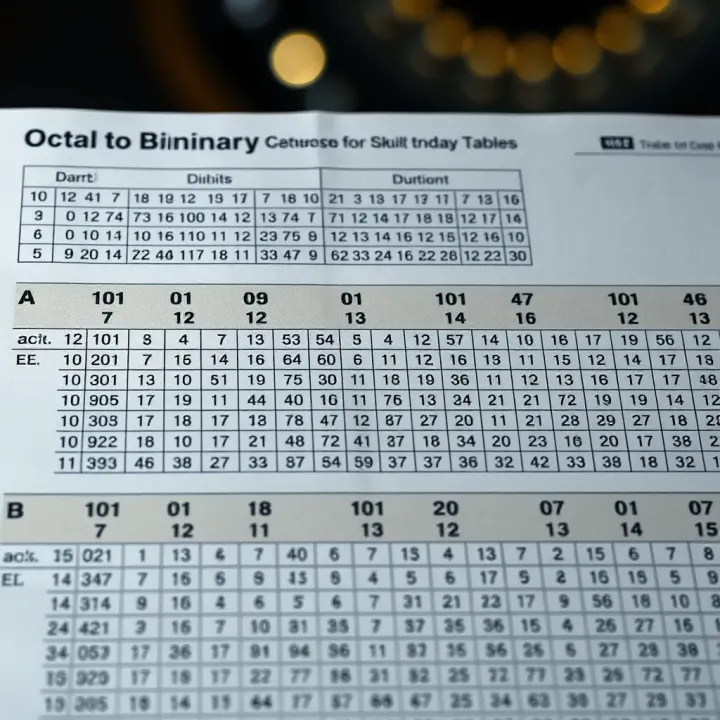
🔢 Learn octal to binary conversion with easy steps, detailed tables, and real examples. Master number systems for better coding and digital understanding! 💻
Based on 7 reviews