
Octal to Binary Conversion Explained
🔢 Learn octal to binary conversion with clear steps, useful tools, and real-world applications in computing and electronics for quick, accurate results!
Edited By
Oliver Reed
Binary to ASCII conversion is fundamental to understanding how computers handle text data. At its core, computers don't process letters as we see them; they use binary digits (0s and 1s) to represent information. ASCII, or the American Standard Code for Information Interchange, acts as a bridge by assigning specific binary sequences to alphanumeric characters and symbols.
Each ASCII character corresponds to a unique 7-bit binary code. For example, the letter 'A' is represented by the binary sequence 1000001, while 'a' uses 1100001. This simple mapping enables computers to convert raw binary data into human-readable text.

Remember, ASCII was designed for English alphabets and basic control characters, so extended versions like Extended ASCII or Unicode exist for other languages and symbols.
Understanding binary to ASCII conversion is not just an academic exercise. Traders analysing market data feeds, developers decoding input streams, and investors working with encrypted information encounter such conversions regularly. By decoding binary inputs correctly, these professionals can transform obscure data into meaningful information.
Practical methods for conversion range from manual translation—breaking binary strings into 7 or 8-bit chunks and mapping them using ASCII tables—to automated tools and programming libraries that handle this task instantly. For instance, in Python, simple commands can convert binary strings directly to ASCII text, streamlining workflows for analysts and developers.
This conversion process supports critical applications including:
Data communication protocols where text is sent over networks
Programming environments where binary outputs must translate to readable logs
Storage systems encoding text in efficient binary formats
By grasping these basics, you equip yourself with the ability to interpret digital information flows used across modern platforms like banking, stock exchanges, and communication systems, ensuring you don’t lose out on any insight due to data representation barriers.
Understanding binary and text representation forms the foundation for converting binary data into readable ASCII characters. It helps traders, analysts, and developers grasp how computers store and process textual information. By knowing how computers translate ones and zeros into text, you can better appreciate the challenges and solutions in data communication, software debugging, and info security.
Understanding the binary number system comes down to recognising that all computer data, including text, images, and sound, is ultimately represented using only two digits: 0 and 1. This system, called binary, is like a language with just two letters that computers use to encode any kind of information. For example, instead of decimal digits from 0 to 9, the binary system deals purely with these two digits in patterns called bits. Eight bits make a byte, which is the common unit for storing data. So, a byte can represent 256 different values, from 0 to 255, giving enough combinations to encode characters and symbols.
Significance of binary in computing lies in its reliability and simplicity for electronic circuits. Using only two voltage levels to represent 0 and 1 reduces errors caused by electrical noise, which is crucial for stable data storage and transfer. In practice, whether you’re entering your PAN card number or reading live stock prices, binary data underpins everything. Even complex transactions in stock exchanges or banking servers reduce down to simple binary codes, making this system the backbone of the entire digital world.
Mapping characters to numerical codes is the process of assigning numbers to each letter, digit, or symbol on the keyboard. For instance, the letter ‘A’ is assigned the decimal number 65, which corresponds to the binary 01000001. This way, when you type a message or store a document, the computer actually saves and processes these numeric codes behind the scenes. Without such a mapping, machines would struggle to understand or display readable text.
Role of encoding standards is critical because they define how these mappings work consistently worldwide. ASCII (American Standard Code for Information Interchange) is one such standard, assigning unique numbers to 128 characters, including English letters, digits, and common punctuation. For broader language support, extended ASCII and Unicode standards expand the range to include special characters, Indian scripts, and emojis. Using these standards ensures that when binary data moves across different systems, the text remains accurate and intelligible.
Without a standard way to represent characters, digital communication would become chaotic, making encoding standards the unsung heroes of text processing.
By grasping these binary basics and how text is represented, you lay a solid groundwork to explore how binary-to-ASCII conversion actually works and its applications across trading software, data analysis, and networking solutions.
Grasping ASCII encoding is essential for anyone working with digital text data. ASCII (American Standard Code for Information Interchange) provides a simple, universal way to represent characters — like letters, numbers, and symbols — as binary numbers. This allows computers to store and share text efficiently, which is especially relevant for traders, analysts, and developers handling data feeds or debugging logs.
Standard ASCII defines 128 characters, using 7 bits for each character. This set includes upper and lowercase English alphabets, digits (0–9), punctuation marks, and some control characters like carriage return. For practical use, this is sufficient for basic English text, which you will find in most simple databases, system messages, or emails.
However, computing needs went beyond this limited set, leading to extended ASCII, which adds another 128 characters (total 256) by using 8 bits. Extended ASCII covers more symbols, accented characters, and graphic elements, useful for regional languages, including certain Indian scripts in bespoke applications. Recognising which ASCII version a system uses prevents errors while converting binary data to readable text.

Each ASCII character converts to a unique binary code. For instance, the letter 'A' corresponds to 65 in decimal and to 1000001 in 7-bit binary. The binary codes are crucial when you extract or decode data streams from trading terminals or when debugging software outputs.
Understanding the fixed length (7 or 8 bits) helps you correctly split binary strings into chunks representing individual characters. Mistaken chunking may lead to garbled text or invalid characters. This knowledge is practical when you manually convert binary to text or write scripts for automated parsing.
ASCII codes cover widely used alphabets (A-Z, a-z), digits (0-9), and an array of special characters such as '@', '#', or '$'. For example, the digit '5' maps to decimal 53, which translates into binary as 00110101. Special characters are crucial in passwords, file paths, or coding contexts popular in software development.
Traders working with APIs or logs often encounter these symbols. Knowing their binary equivalents enables precise data interpretation, especially when raw binary logs form part of system diagnostics or audit trails.
Here are common ASCII characters and their binary codes:
'A' = 01000001
'a' = 01100001
'0' = 00110000
Space = 00100000
Having a clear mapping helps when troubleshooting incorrect character displays or when you process binary messages from stock exchanges, ensuring data is rendered exactly as intended.
When working with binary to ASCII conversions, remembering these binary formats and character mappings lets you quickly verify your conversion process is accurate—avoiding costly misinterpretations in financial data or software workflows.
Understanding ASCII encoding simplifies many data-handling tasks, making it a must-know foundation for anyone processing textual information at the binary level.
Converting binary data into ASCII characters is a vital skill for those working with digital information, especially in fields like trading, software development, and data analysis. This process turns sequences of 0s and 1s into meaningful text, allowing better interpretation and usage of data. Various methods and tools simplify this task, ranging from manual techniques to online converters and programming scripts.
Breaking binary strings into bytes involves splitting a long string of binary digits into groups of eight bits each, as one byte corresponds to one ASCII character. For example, the binary string 01001000 01100101 01101100 01101100 01101111 breaks down into bytes representing individual characters. This step is crucial; if the grouping is off, the whole conversion will be incorrect.
Converting binary to decimal comes next. Each byte in binary is converted into a decimal number by calculating the sum of powers of two where bits are set to 1. For instance, the binary byte 01001000 converts to decimal 72. This decimal number then serves as the key to find the corresponding ASCII character.
Mapping decimals to ASCII characters means matching the decimal values to ASCII's standard character table. The decimal number 72, in this case, corresponds to the uppercase letter 'H'. This mapping is essential for translating machine-level data into readable content, often used during debugging or when analysing raw data files.
Several popular online tools are available in India that help convert binary to ASCII quickly without manual calculations. Sites like RapidTables, Browserling, and CodeBeautify provide free binary to ASCII conversion services. These tools are practical for traders and analysts who may not have time to manually convert data but need to interpret binary messages or logs fast.
Using these converters is straightforward. First, paste or type the binary string into the input box, making sure the binary is grouped correctly into bytes. Then, click the 'Convert' button to get the ASCII output instantly. This hands-on approach saves time while maintaining accuracy, especially for large amounts of data.
For those comfortable with coding, writing simple scripts is an efficient way to convert binary to ASCII. Both Python and JavaScript offer easy methods to automate this. In Python, functions like int(binary_string, 2) convert binary directly to decimal, while chr() maps it to ASCII. Similarly, JavaScript allows converting binary segments using parseInt() and String.fromCharCode(). These scripts help automate repetitive tasks and integrate conversion processes into larger applications.
Using programming for conversion has clear benefits in software development and data processing. It enables bulk processing of data streams, automatic decoding of messages from hardware devices, or logs during debugging. Where time and accuracy are paramount, such scripts become indispensable tools in the workflow.
Accurate binary to ASCII conversion is essential for translating machine-readable data into human-readable form, making information accessible and actionable for professionals across industries.
Binary to ASCII conversion is a fundamental process widely used across many technology sectors. Understanding its applications helps highlight why translating binary data into readable text is vital in modern digital environments. This section explains two main areas where binary to ASCII conversion plays a significant role: data communication and networking, and software development combined with debugging.
Every message transmitted over a network gets converted into a stream of binary data — sequences of ones and zeros. However, these raw binary streams are not directly human-readable. That’s where binary to ASCII conversion comes in. It transforms these binary sequences back into characters or symbols we understand, supporting proper interpretation and processing of the message at the receiving end.
For instance, when you send a text message via WhatsApp or SMS, the content travels as binary data over the network. The recipient’s device then converts this binary stream into ASCII characters, rendering the text on the screen. Without this conversion, the data would remain a meaningless pattern of zeros and ones, useless for communication.
Message encoding ensures that information can be transmitted reliably without corruption, while decoding reverses this process for the receiver. Binary to ASCII conversion plays a crucial part here by acting as the standard method to encode text data into a binary form suitable for transmission and decode it back to text upon receipt.
In networking protocols like HTTP or SMTP, text headers and content are often encoded in ASCII binary form. As messages pass through various routers and servers, ASCII encoding acts as a universal standard making sure devices, regardless of make or software, can understand and process the data correctly. This standardisation reduces errors and boosts communication efficiency.
Developers often deal with binary files and logs generated by applications. These files can be unreadable without conversion to ASCII because they consist of binary sequences representing error messages, statuses, or operational data. Converting these sequences into ASCII format helps developers quickly understand what the program is logging or encountering.
For example, when a program crashes, the debug log might store error codes and messages as binary. By converting these to ASCII, developers can read meaningful error messages and trace the cause without sifting through raw binary code, reducing the time to fix bugs drastically.
Binary to ASCII conversion simplifies complex data display by making it readable to humans during software testing and development. Tools like hex editors or console outputs use this conversion method to display program outputs, user inputs, or network packets clearly.
Even when working with encrypted or compressed data, parts of the information may need to be translated to text for verification, testing, or documentation. Binary to ASCII conversion acts as a bridge between machine-level data and human understanding, supporting smoother development workflows.
Accurate and efficient binary to ASCII conversion is not just an academic exercise—it directly impacts everyday tech interactions and development processes by enabling clear communication between machines and humans.
Together, these applications show how the process enables seamless data exchange and aids the software lifecycle, reinforcing its importance across industries and technologies.
When working with binary to ASCII conversion, troubleshooting common issues is essential. Incorrect conversions often stem from simple errors in input or misunderstandings about encoding standards. For traders, analysts, or software developers handling data streams, identifying and fixing these issues quickly saves time and prevents costly errors in data interpretation.
Verifying binary string length is a basic yet crucial step. ASCII characters are represented by 7 or 8 bits (commonly 8 bits for extended ASCII). If your binary string length isn’t a multiple of 7 or 8, the conversion will likely produce incorrect or garbled characters. For instance, the binary string 0100001 is 7 bits and represents one ASCII character. However, if you receive a binary string of 10 bits, you must first check if the last bits belong to the next character or if there is extra padding. This helps avoid misalignment, which might output entirely wrong characters.
Checking for invalid characters means ensuring the binary string contains only '0' and '1'. Sometimes, when data is copied or transmitted, stray characters like spaces, commas, or even alphabets may get inserted mistakenly. Such invalid characters break the binary pattern and cause errors during conversion. Practical tools or scripts typically reject non-binary characters, but manual checks or simple validation functions in your program can catch this early. For example, a trader analysing coded messages should clean the input binary data before any conversion attempt.
Differences between ASCII and Unicode affect binary to ASCII conversions significantly. ASCII is limited to 128 or 256 characters, while Unicode covers a vast range of global scripts and symbols. If binary data represents Unicode characters but is interpreted as ASCII, output will appear incorrect. This is common when working with multilingual data or special symbols not in the ASCII set, such as Hindi characters or emoji. Knowing whether your binary stream uses ASCII encoding or Unicode (like UTF-8) guides proper decoding. For instance, an analyst receiving market news feeds in regional languages must consider Unicode decoding instead of ASCII.
When binary does not map correctly to ASCII, it usually means one of the following: the binary data may be incomplete, corrupted, or encoded with a different standard. For example, binary output generated by certain software might use a proprietary encoding or contain padding bits for error correction. Attempting to convert such data directly to ASCII can produce unreadable output or question marks. The practical solution involves understanding the source encoding first or using tools that auto-detect encoding schemes. In trading platforms, misinterpreting binary data feeds can cause wrong signals, so verifying the correct encoding upfront is key.
Careful validation of binary input and clear knowledge of encoding standards prevent most common errors in binary to ASCII conversion.
By following these troubleshooting steps, you ensure reliable and accurate interpretation of binary data into readable ASCII characters, which is vital for data processing and communication in many tech-driven sectors.
🔢 Learn octal to binary conversion with clear steps, useful tools, and real-world applications in computing and electronics for quick, accurate results!

Learn to convert between binary and decimal systems easily 🔢. Step-by-step methods, practical examples & uses in computing help you master these essential tech skills.
📟 Explore how binary calculators perform arithmetic using the binary system, their key role in computing, comparisons with decimal tools, and practical uses across industries.
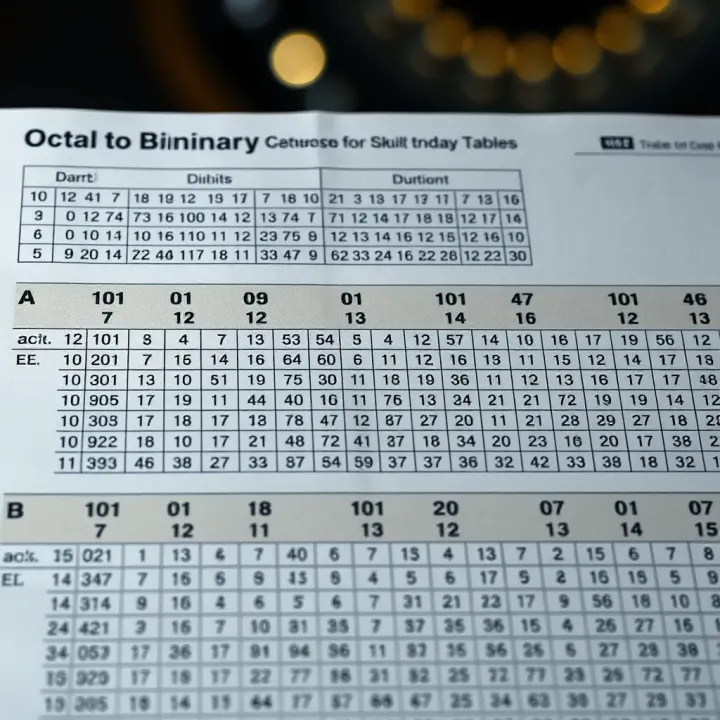
🔢 Learn octal to binary conversion with easy steps, detailed tables, and real examples. Master number systems for better coding and digital understanding! 💻
Based on 11 reviews