

Understanding Brokerage Charges in Intraday Trading
Explore how brokerage charges affect intraday trading profits in India ⚖️. Learn various fee models, broker comparisons, and smart tips to cut costs 💡.
Edited By
Isabella Wright
Intraday trading lets you buy and sell stocks on the same day, aiming to make profits from small price moves. However, traders often overlook the various charges associated with such trades. These expenses can eat into profits quickly if you don't know where to watch out.
In India, intraday trading involves multiple costs beyond just the buying price. Brokerage fees, transaction costs levied by exchanges, Securities Transaction Tax (STT), Goods and Services Tax (GST), and stamp duty all add up. Each charge varies by broker and market segment, so traders must understand their impact.

For example, even a tiny brokerage per trade can multiply since intraday traders often execute several trades daily. This reduces net gains significantly if not managed well.
To manage intraday trading successfully, it is essential to familiarise with how these charges apply. Knowing this helps you calculate your breakeven point more precisely and plan trades with better profit margins.
This section will break down key fees involved in intraday trading on Indian stock exchanges, explaining their calculation and examples of typical values. Understanding these costs supports smarter decision-making on trade frequency, choice of broker, and strategy.
Brokerage is the fee a broker charges for executing your buy or sell order. It may be a percentage of trade value or a flat rate per trade. Most discount brokers offer flat rates of ₹20–₹50 per trade regardless of size, making intraday trading affordable even with small lot sizes.
STT applies to purchase and sale of equity shares. For intraday delivery trades, STT is not charged on buy side but levied at 0.025% on the sell side of equity intraday trades.
Both National Stock Exchange (NSE) and Bombay Stock Exchange (BSE) charge transaction fees based on trade value. These charges are usually fractions of a percent, around 0.00325% on equity intraday trades.
GST at 18% applies on brokerage and transaction charges combined. This inflates overall trading costs.
Stamp duty varies state to state, generally around 0.003% on intraday trades. Some states charge stamp duty only on buy side, some on both sides.
Additional charges include Securities Clearing Corporation of India Ltd (SCCL) fees, depository participant charges for holding securities, and possible account maintenance fees.
With these costs in mind, intraday traders should carefully calculate total expenses per trade to avoid surprises at settlement and protect profits. Next sections will explain each charge in detail with real examples.
Intraday trading involves quick buy-and-sell actions within the same trading day, making cost efficiency key to profits. Understanding the common charges is essential because even small fees can eat into tight intraday margins. Traders often focus on brokerage rates but discounts or hidden costs elsewhere can upset the balance.
Brokerage fees come in two main forms: flat-rate and percentage-based. Flat-rate brokers charge a fixed amount per trade—say ₹20 regardless of trade size. This suits high-volume traders whose trade values vary greatly, as costs stay predictable. Percentage brokerage charges, like 0.03% of the transaction value, can be cost-effective for smaller trades but become expensive as trade size grows.
For example, on a ₹50,000 trade, a 0.03% commission equals ₹15, cheaper than a ₹20 flat fee. But for a ₹3 lakh trade, flat fees clearly win. Choosing between these models requires assessing one’s average trade size and frequency thoroughly.
Brokerage directly cuts into the net gains from intraday trades, which often rely on small price movements. Imagine you earn a ₹500 gross profit, but brokerage on both buying and selling totals ₹50. That’s a 10% hit right away. On multiple trades daily, these fees compound quickly, squeezing profit margins.
Thus, traders must factor brokerage into their breakeven calculations. Opting for the cheapest brokerage might not always be wise if service quality suffers or execution slows, affecting the profitability of fast-paced intraday decisions.
The National Stock Exchange (NSE) and Bombay Stock Exchange (BSE) levy transaction charges on every trade, deducted by brokers before passing it on to traders. These charges pay for the exchange’s infrastructure and regulatory functions. Though small per trade, they add up with frequent intraday deals.
On average, these fees range around ₹10-₹20 per crore traded. For instance, a ₹1 crore turnover attracts roughly ₹15 in transaction charges. While seeming minor, ignoring them risks underestimating total trading costs.
NSE and BSE charge slightly different rates, with NSE generally at a tad lower level, attracting most intraday traders. For BSE, charges might be marginally higher but can provide more liquidity in certain stocks. Traders choosing their preferred exchange must consider this subtle cost difference because it affects overall expenses, specially for high-frequency traders who often switch between exchanges.
STT is a tax by the government imposed at the exchange level on securities transactions, including intraday trades. For intraday equity trades, STT applies only on the sell side. This means if you buy shares worth ₹1 lakh and sell the same day, STT charges apply on the sale amount.
The tax collection is automatic via the exchanges and passed on to traders through brokers. Since STT reduces the effective returns, accounting for it in profit calculations is essential.
For intraday trading in equities, STT is charged at 0.025% on the sell transaction value. Suppose you sell shares worth ₹2 lakh intraday; STT payable would be ₹50 (0.025% of ₹2,00,000). Though this is modest, the tax expense compounds when multiplied by numerous daily trades.
Understanding how STT impacts your net gains helps avoid surprises, ensuring you calculate realistic profit targets that include all mandatory charges.
Many traders focus mainly on brokerage fees and transaction charges, but several other costs quietly chip away at intraday profits. Overlooking these can mislead you about the true profitability of your trades. A clear understanding of these additional costs helps you better plan and optimise your trading strategy.
Understanding GST on Brokerage Charges
Goods and Services Tax (GST) applies to the brokerage fee charged by brokers. Currently, GST is levied at 18%, comprising 9% Central GST (CGST) and 9% State GST (SGST), or 18% Integrated GST (IGST) in interstate situations. For example, if your broker charges ₹50 as brokerage on a trade, you pay an additional ₹9 as GST, increasing your overall expenses.
GST is applicable only on the brokerage component, not on the transaction or other fees. Traders often miss this detail, resulting in underestimated costs. Ignoring GST can reduce your small intraday margins quite significantly over large volumes.
How GST Influences Total Trading Costs
Since GST adds to brokerage fees, it effectively pushes up the cost per trade. For high-frequency intraday traders, these seemingly small amounts accumulate quickly, impacting net profits. If you trade 30 times a day and brokerage per trade is ₹50, GST adds up to ₹270 daily, or ₹5,400 per 20 trading days.
Thus, when calculating breakeven points, factor GST as a part of your fixed trading costs. Some brokers absorb GST in their pricing for competitive edge, but most pass it on. Knowing its effect helps you choose brokers offering transparent fee structures.
State-wise Variation in Stamp Duty Rates
Stamp duty on securities transactions is a state-level levy varying according to where your broker is registered. For example, Maharashtra charges 0.002% on intraday trades, while Karnataka levies 0.05%. These differences can tilt trading costs substantially depending on your broker’s location.
Traders rarely consider this factor but switching to a broker in a state with lower stamp duty could save thousands annually. If you live in Delhi but your broker is registered in Tamil Nadu, the Tamil Nadu stamp duty applies.
Impact of Stamp Duty on Intraday Trading
Though stamp duty rates per trade look minuscule, frequent intraday trades magnify their effect. For instance, on a ₹1 lakh trade, 0.05% equals ₹50 in stamp duty. Doing 20 such trades daily leads to ₹1,000, or ₹20,000 per month—significant for retail traders relying on narrow margins.
Since stamp duty isn't negotiable, understanding its impact helps you factor it into your overall cost calculations. This awareness allows better comparison between brokers who might have similar brokerage but different stamp duty costs.
Annual Charges and Frequency
Maintaining a Demat (dematerialised) account involves yearly fees, varying by Depository Participant (DP). Banks typically charge between ₹300 to ₹500 annually, while discount brokers can offer lower fees or waive them for active traders.
Though not a trading-specific fee, this charge adds to your intraday cost bucket, especially for those who use multiple brokerages. Some default Demat accounts have hidden charges like custodian fees and transaction fees as well.
How Demat Fees Add to Overall Expenses
Demat maintenance fees might seem small but combine with other regular costs. For traders making slim profits, ₹400 yearly translates to roughly ₹33 per month or ₹1 per trading day—a cost that cuts into steady gains.
Considering Demat fees when switching brokers or starting a new account is wise. Brokers offering zero Demat AMC (Annual Maintenance Charges) or discounts for intraday traders can help you reduce your overall expenses, enhancing net profitability.
Understanding these often overlooked costs—GST, stamp duty, and Demat charges—completes the picture of your true trading expenses. Factoring them in can improve your strategy and help identify the best broker to maximise your intraday profits.
Understanding the role of charges is vital for anyone involved in intraday trading. Every broker's fee, transaction cost, or tax directly chips away at your profits. Traders often overlook these expenses, focusing only on price movements, but ignoring charges can make a winning trade turn unprofitable.
Start by adding all relevant costs: brokerage fees, Securities Transaction Tax (STT), exchange transaction charges, Goods and Services Tax (GST) on brokerage, and stamp duty. For example, if you buy shares worth ₹1,00,000 and your broker charges 0.03% per trade as brokerage, along with standard STT and transaction charges, add up all these costs to arrive at your total expense. Including the same costs for selling, your breakeven price rises beyond just the purchase price.
This calculation helps you set realistic targets. Suppose the total charges amount to ₹250 per trade cycle. Your stock’s price must move favourably enough to cover this ₹250 before you start seeing gains. If not accounted for, small profits can easily be wiped out.
Intraday traders often aim for small percentage gains, sometimes just 0.5% or less. However, if charges consume a significant part of this gain, the effort turns futile. For instance, a ₹100 profit per trade might look good on paper, but after paying ₹50 in brokerage and taxes, you're left with half that amount.
High charges not only affect potential earnings but also influence trade frequency and strategy. If costs are steep, traders may reduce trades or shift to higher volume, lower-charge brokers. Overall, recognizing the drag of expenses helps in managing risk and choosing trades with realistic profit expectations.
Discount brokers like Zerodha or Upstox offer flat or minimal brokerage charges, making them popular for intraday traders seeking cost efficiency. In contrast, full-service brokers such as ICICI Direct or HDFC Securities charge higher fees but provide research tips, advisory services, and customer support.
For a trader executing multiple intraday trades daily, discount brokers significantly cut costs, increasing net profitability. However, full-service brokers might suit those who value guidance or plan also to invest long term, despite higher charges.
While low brokerage is attractive, traders should weigh other factors like platform reliability, execution speed, and hidden fees such as account maintenance or withdrawal charges. Slow order execution during volatile markets can lead to losses outweighing savings on brokerage.
Also, consider the ease of access to tools like margin funding or advanced charting. Sometimes paying a slightly higher brokerage can be justified if the broker’s platform or services improve trading effectiveness. Thus, a comprehensive view beyond just rates ensures you optimise costs without compromising on quality.
Carefully calculating all charges and choosing the right broker helps intraday traders safeguard their profits from being eroded by hidden expenses, enabling smarter trading decisions.
Reducing costs is key to improving your intraday trading profitability. Small savings on charges can add up over many trades, helping you keep more of your earnings. Understanding how brokerage, transaction fees, and taxes affect your total costs lets you choose strategies and tools that suit your trading style and volume.
If you trade frequently or in large volumes, flat-fee brokerage plans can work out cheaper. These plans charge a fixed fee per day or per month instead of charging a percentage of each trade’s value. For instance, if you execute dozens of trades daily, paying ₹20 as a fixed fee can be far less than 0.03% brokerage per trade on high turnover. Zerodha's '₹20 per trade' model is a popular example that benefits high-frequency intraday traders by keeping charges predictable and lower overall.
Traders who enter the market occasionally or with smaller volumes might find percentage-based brokerage easier. These charges scale with your trade size, meaning you pay only when you trade. For example, ICICI Direct charges a set percentage per trade which works well for investors making a handful of intraday trades monthly. This approach avoids paying fixed fees when you trade less often and better suits casual or part-time traders.
Peak trading hours often come with higher volumes and sometimes increased transaction costs due to network congestion and slippage in limit orders. If your strategy allows, try trading slightly outside the highest volume windows, such as mid-morning or late afternoon sessions. This can lower your bid-ask spread and reduce transaction charges on some broker platforms. However, timing must not compromise your trade entry or exit quality.
Certain brokerages or exchanges may offer reduced transaction fees during extended or off-market hours. For example, pre-open sessions or after-market hours sometimes have different fee structures or lower brokerage. By familiarising yourself with these periods and aligning your trades accordingly, you can trim down costs.
Many brokers offer mobile apps with reduced charges compared to desktop platforms, thanks to lower operational costs. Apps like Upstox, Zerodha Kite, and Groww often provide slimmer brokerage rates and zero fees on order modifications or cancellations. Trading via mobile apps not only brings convenience but also lowers cost overheads.
Automation software like Algo trading platforms can minimise costly slip-ups such as repeated orders or missed stop-loss triggers. These tools help execute orders faster and more accurately, preventing unnecessary transaction fees or losses. Though such services might have setup costs, their ability to streamline trades can save you money over time by reducing errors and associated charges.
Keeping an eye on charges and tailoring your trading approach accordingly can make a significant difference in your net gains from intraday trading.
Explore how brokerage charges affect intraday trading profits in India ⚖️. Learn various fee models, broker comparisons, and smart tips to cut costs 💡.
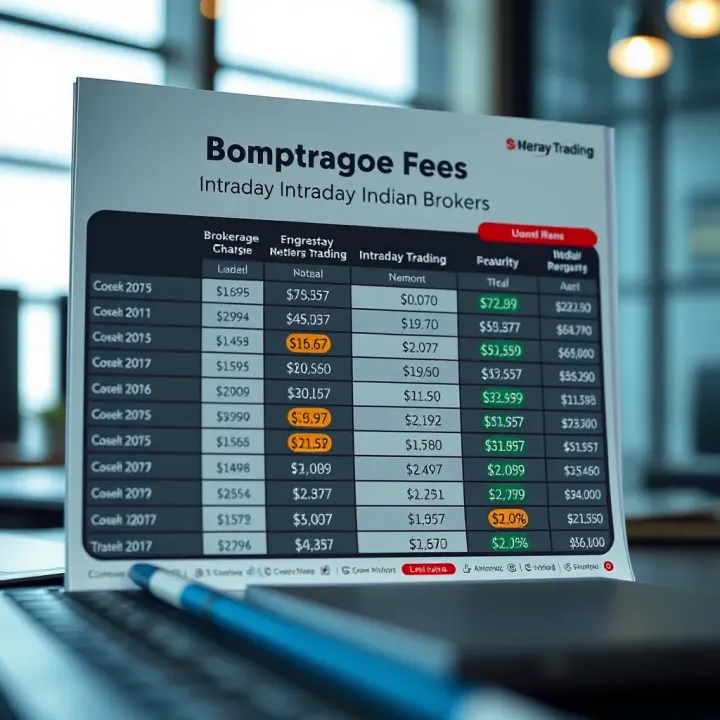
🔍 Discover how to find the lowest brokerage charges for intraday trading in India. Compare brokers, learn cost factors & get tips to save on fees and boost returns!
Find the best broker for intraday trading in India 📈 Compare brokerage fees, platform features, regulatory compliance, and customer support for informed choices.

📈 Discover how to pick the best shares for intraday trading in India with smart strategies, market insights, risk tips, and popular stock choices to boost your trades.
Based on 12 reviews